Article
Viewpoint: police and the recent trials and tribulations of social media
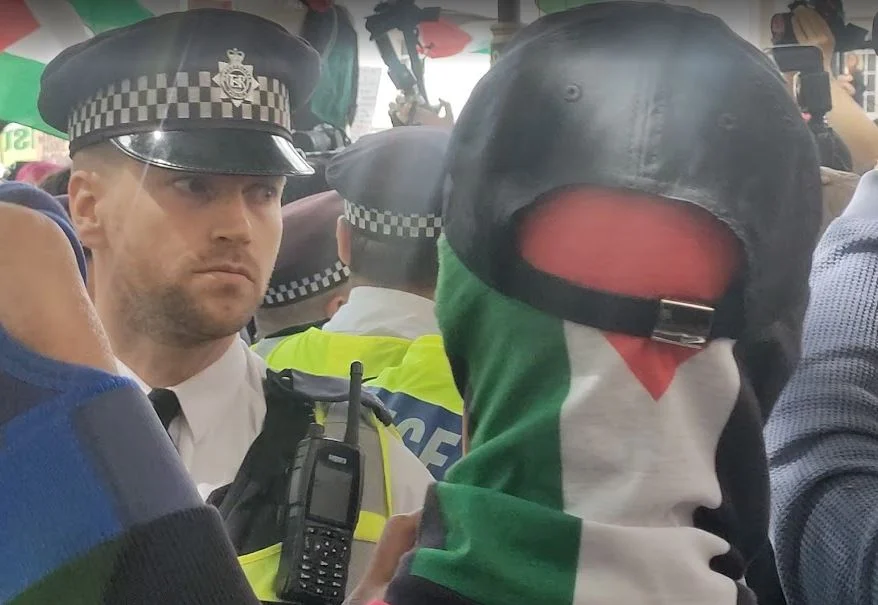

Chris Hobbs argues that the portrayal of a public order incident on TV failed to paint the full picture of events that he witnessed on the ground.
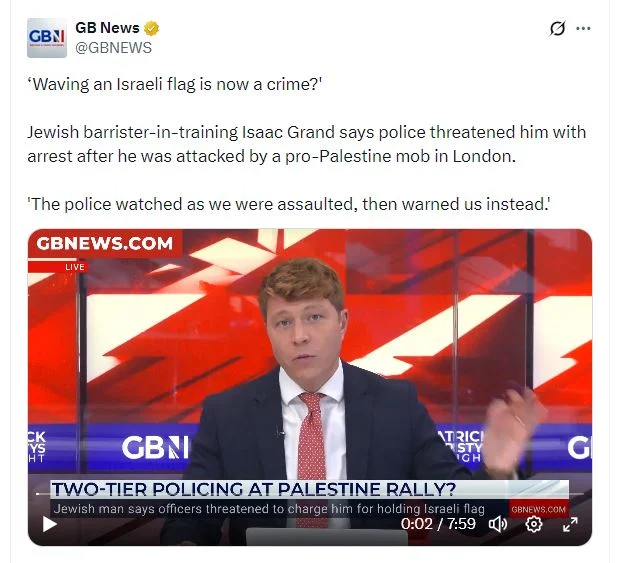
It was pattern oft repeated on ‘X’ aka Twitter; brief footage of an incident accompanied by a misleading account that purports to accurately describe the circumstances. This particular clip featured prominently on GB News some weeks ago and has, as is often the case, just resurfaced on ‘X.’ It refers to a protest that took place by Trafalgar Square on the 23rd June; the protest was against the designation of Palestine Action as a terrorist organisation.
The indignation that permutates the footage concerns ‘harsh’ police treatment of those who ‘merely’ waved an Israeli flag during the protest. The ‘innocents’ were placed on to a bus and threatened with arrest by clearly irate officers,
The reality, as witnessed by me, was that the ill-tempered protest had been continuing for some time. There had been several clashes with police with arrests being made. Suddenly, in the midst of what was, in any event, an acrimonious affair, pro-Israelis, complete with flag, suddenly materialised amongst those with opposite views.
These and other pro-Israeli ‘Inserts’ frequently appear in the midst of pro-Palestinian protests attempting to provoke a violent reaction. They are normally treated with disdain before being removed by police. One ‘Insert’ has been arrested on several occasions.
On this occasion, the presence of pro-Israeli ‘Inserts’ provoked an angrier than usual reaction from the already agitated pro-Palestinian crowd: The two individuals primarily concerned were, for their own safety, bundled by officers onto the bus which had been effectively marooned by the protest. The officers made no secret of their anger but far from being grateful, the two individuals seemed to feel that their democratic rights involving the unfurling of an Israeli flag in the midst of a pro-Palestinian protest, were being usurped.
Fair play to the Met; they responded robustly to this version of events as shown on GB News, providing a version which mirrors that above with a full explanation of police actions and tactics. They made it clear that if the situation had been reversed, police action would have been exactly the same. It was an excellent response.
The GB News presenter Patrick Christys, appeared to agree with this sentiment when one of the two protesters appeared on his programme; In fairness I have to say that, having appeared on Patrick’s programme, he is not only personable but unlike some presenters, allows police commentators to have their say.
Police tactic
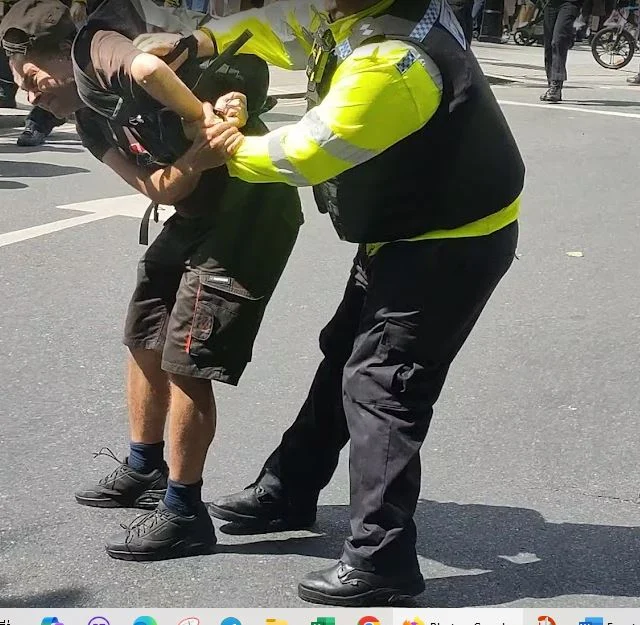
The programme made no acknowledgement of the fact that a common tactic of police forces in the civilised, democratic world is to keep rival groups apart in order to literally ‘keep the peace.’ This applies whether the groups are divided on political grounds or are rival football fans. Those who feel that counter-protesters have a legitimate, democratic right to appear in the midst of their rivals would presumable be content for Spurs and Arsenal fans to ‘mingle’ on the terraces. In fact, last season’s match at the Spurs ground saw Arsenal fans who had tickets amongst their rivals being violently assaulted while after the match police in ‘riot gear’ came under attack as they struggled to keep rival fans apart,
It’s worthy of note that pro-Israeli events, whilst generally well ordered with competent security provided by the Community Safety Trust, haven’t been without incident. At the conclusion of the first pro-Israeli rally in Trafalgar Square, a small group of youths provoked fury when, as participants were leaving, they unfurled a Palestinian flag. They were duly detained by police.
At a further rally in Trafalgar Square a small group from the Jewish anti-Zionist Neturei Karta sect arrived with several pro-Palestinian activists and stood silently on a traffic island on the edge of Trafalgar Square. They were in possession of a long wooden placard which was smashed by an individual who had emerged from the pro-Israeli gathering. Another individual was struck in the face and police had to place a cordon around this group before escorting them away as the event ended.
At further pro-Israeli counter protests called to oppose the large ‘national’ Palestinian marches and rallies, there were angry reactions when pro-Israelis perceived that small groups of their rivals were attempting to confront them.
Two-tier policing is frequently referred to by GB News and by those on the right of the political spectrum. There is no acknowledgement of the fact that those on the left, notably Islamic and pro-Palestinian groups, have also made allegations that amount to two-tier policing claiming that police are biassed against them and heavy handed.
Fascists or flashes
More recently, the allegation of two- tier policing has surfaced again during the recent issues concerning ‘migrant hotels.’ GB News highlighted footage taken by an ‘independent’ journalist during the tensions at Epping.
The undated footage appears to show nervous police officers in riot gear (helmets clipped) escorting and hurrying anti-racists along a rural road. A police supervisor is deemed by accompanying ‘independent’ journalists to have said’ if you see any fascists left or right,’ when instructing his officers. This caused outrage amongst those ‘independent’ journalists who felt that peace loving protesters were being stigmatised and police, in their riot gear perhaps fearful of an ambush from those who were not peace loving local residents, were taking sides. Others, including Essex Police, state that the officer said ‘flashes’ and I have to say, from the footage it sounded like ‘flashes’ to me.
The anger from one independent’ journalist transferred itself to a GB News item presumably on the grounds that those concerned about the welfare of their children shouldn’t be referred to in derogatory terms.
However, if the footage was taken on the day when there was serious disorder in Epping to the extent that reinforcements had to rushed in from other forces; expecting police, in any event, to be circumspect in their use of language is perhaps asking rather a lot. There were also fears of an ambush during the major Sunday protest when anti-racists were walked to and from the hotel having gathered in the station car-park. However, the behaviour of both sides on that day was near exemplary.
In relation to the flashes/fascists dispute some with a sense of humour and memories of police parlance have mischievously suggested that it was neither fascists nor flashes but ‘flashers.’
The bussing myth
There was, however, during the Epping unrest, a damaging example of news distortion when social media claimed that anti-racist protesters were ‘bussed’ by police to the Bell Hotel where the anti-migrant protest was taking place. This news swept across social media with ‘filmed evidence.’ Essex police ‘comms’ were slow to react to the allegations which gained credence to the extent that Nigel Farage was berating Essex Police for their actions.
In fact, it was stated and proven that anti-racist counter-protesters were placed in Met police carriers and taken from the protest site to the station for their own safety due to the level of violence within the town. They were not ‘bussed in’ to the protest but escorted by police on foot. Farage later grudgingly admitted he had got it wrong but the damage had been done.
The subject of distorted and fake news directed against police, as it appears on social media, is a subject worthy of serious academic study. One inevitable conclusion to any such study would surely be that police ‘comms’ need to be far more agile in their response to those with sinister motives in trying to undermine the UK’s police service and, more importantly, its officers.
Chris Hobbs is a former Special Branch officer.
Category: Public Order
Chief officers are so slow to react to rapidly evolving events because they are terrified of upsetting anyone from the permanently offended on the left or the right. The deafening silence that echo’s whenever policing is criticised, be it the service as a whole, individual forces or individual teams, or specific officers. Very rarely, if ever does a chief officer rebuke incorrect and downright wrong and fabricated commentary and set the record straight. The Manchester Airport incident was a prime example. The police approach to the rapidly evolving world of 24/7 rolling media has been “lead footed.” The desire of chiefs to say absolutely nothing or as little as possible in defence of officers working in really difficult circumstances, is rapidly highlighting the vacuum of assertive, genuine, emotional intelligent and experienced leadership across almost every force in the country.
Really good comment. I think this extends down the ranks too. If Chiefs don’t set the example, the front line become unsure and apologetic for simply exercising their powers in the course of their duties. That’s where we are. Enough. Know your role, know your powers, know the law and perform your duty. And don’t let anyone tell you otherwise. And if someone wants to criticise, listen but stand-up for yourself. Chiefs should be doing that for all under their command.
Advertisement
Job of the week
Crime Scene Investigator
- The Royal Gibraltar Police
- Gibraltar | New Mole House Police Station
- £38,000, £39,000, £40,000, £41,000, £42,000 per annum.
RGP Police Officers and staff are committed to providing a professional service and our vision of “Delivering a Safer Gibraltar through Excellence in Policing” reinforces this. All Officers and staff are ambassadors for the force and are encouraged to be helpful, polite, approachable and professional. We are all responsible for delivering a professional policing service to all people across Gibraltar. We subscribe to and live by our organisational values and Code of Ethics which sets out both what the public can expect from us and what we should expect from one another.
Read moreCoffee break