Article
Firm, good-humoured and humane: the Met’s troubled rank and file at Carnival


Chris Hobbs witnesses the professionalism of officers during an unpopular duty as they face cuts and job turmoil.
In many organisations where morale is low, the performance of its workforce invariably takes a downward turn. There can be little doubt that morale in the Met has massively suffered during recent years and taken that sharp downward turn in the light of recent events. There is much that is unsettling rank and file officers at present.
They are only too well aware of the Commissioner’s oft repeated assertion as to the hundreds of officers he wants rid of with only the occasional line offering praise and support for the majority. Meanwhile we have the cutbacks which are affecting many officers who are now uncertain as to where their future lies as various departments and units close or are re-organised.
Into this chaotic mix officers can now add a new form of tenure which revolves around ‘ten years and you’re out,’ meaning after ten years in a particular role away from a borough BCU the officer has to move. A consequence of this appears to be that officers approaching twenty-five years’ service and who are liable to be ‘tenured’ will simply take early retirement rather than go to a new role.
That these issues did not adversely affect both the commitment, good humour and patience of officers over those two long days of Notting Hill Carnival celebrations says much for the workforce. Carnival is an Afro-Caribbean celebration that welcomes all, but the majority of those attending are from the black community.
Hostility towards and assaults on police
Despite activists constantly claiming that relations between Met officers and those from that community are, to say the least, acrimonious if not broken, there is little sign of that across Carnival. The Met’s pre-event ‘raids’ that saw 100 arrests and the presence of facial recognition cameras which resulted in 61 arrests will also have dissuaded some undesirable elements. However, the fact that there were 55 assaults on officers illustrates that there are still pockets of hostility towards police; two required hospital treatment; one for a broken nose and the other for a badly bitten hand. Nevertheless, relations between the overwhelming majority of the million or so Carnival goers and police were generally excellent.
Positive observations
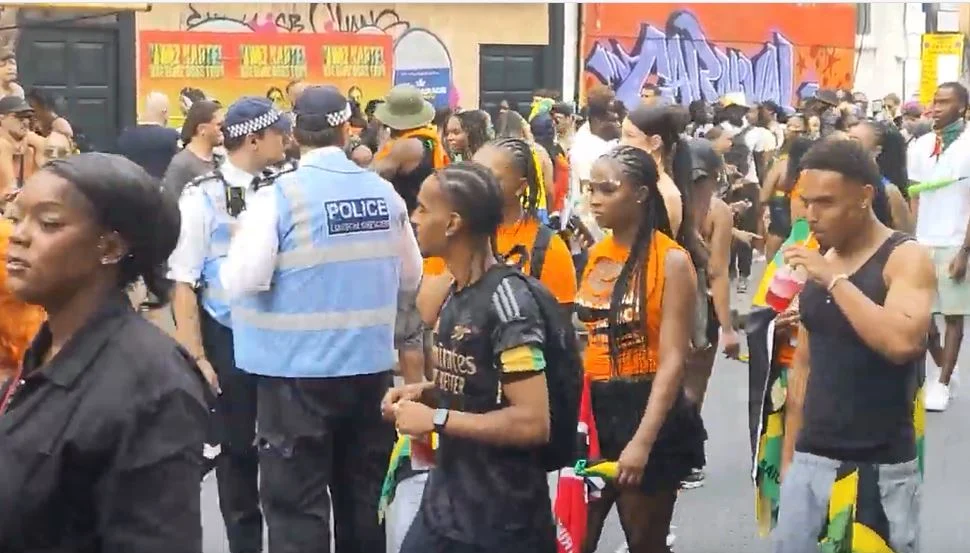
Searches at the detection arches saw little adverse reaction from those being searched or even from individuals arrested. Those witnessing police searching and arresting were content to let them carry out their duties without comment while many stop and search interactions saw smiles and humour from both searcher and searched.
Officers that I witnessed who were escorting handcuffed prisoners on foot through the dense Carnival crowds received not even a hint of criticism. This was in marked contrast to recent protests, be they from the left or right of the political spectrum, where arresting officers are invariably surrounded by a jostling mob with chants of ‘let him/her go.’
Officers could also be seen, across the carnival footprint, compassionately tending to those who had become unwell or injured during the celebrations. I witnessed the heavy lifting involving a ‘stretcher blanket’ of an unconscious male while police medics moving stricken individuals using ‘job wheelchairs’ could be seen across Carnival.
Mercifully, this year, officers were spared from having to battle in vain to save the lives of stabbing victims yet that they are able to switch from one role to another, then to yet another within minutes is a testimony to both their skills and humanity.
Fair evasion and escape
I was somewhat concerned that the rampant fare evasion I witnessed on arrival at Paddington Station on Monday, was a distinctly unpromising omen for the day ahead. It would have needed massed ranks of BTP officers to have dealt effectively with this issue.
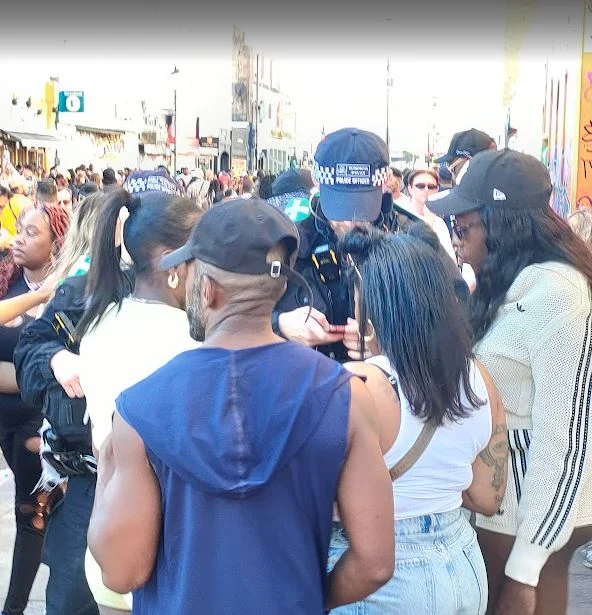
Then, adjacent to Paddington Station, revellers could see on full view, the controversial Facial Recognition System vehicle. Alas, within seconds of me walking past it, there was a hue and cry as an athletic individual dressed in shorts and trainers, realised he was about to be grabbed and made a run for it. The heavily laden officers had no chance of catching up with him.
Wild eyed, foul mouthed, violent and duly arrested
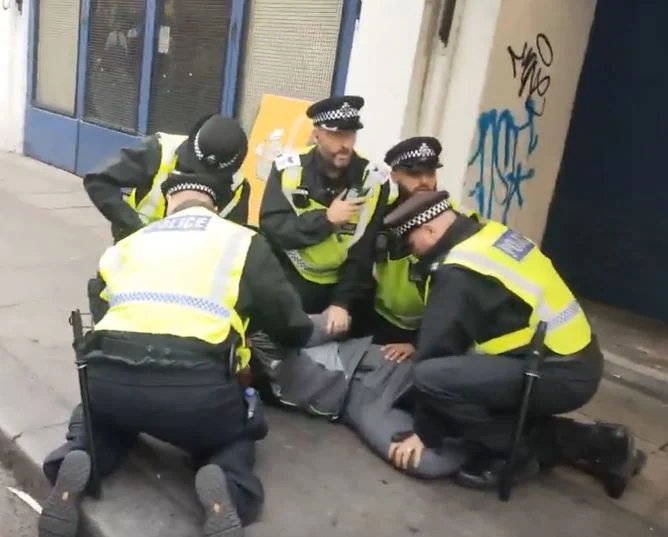
On the Sunday, my reputation for magnetically attracting the undesirable (there is an unprintable phrase for this) was enhanced when I saw a white male dressed in all- grey attire, become involved in an altercation with some revellers. He appeared, ‘off his head’ on something and as he walked off, such was his wild- eyed, foul- mouthed demeanour, old instincts kicked in and I decided to change direction and follow him.
After a couple of hundred yards, I spotted a serial of officers walking in the same direction on the opposite side of a crowded road. I pointed the individual out to the sergeant who promised to ‘keep an eye’ on him. I fell back but then, after a couple of minutes I saw the serial swarm across the road. It would appear that the individual in question punched a member of the member in an unprovoked attack.
He was restrained with some difficulty and continued to shout and swear. Attempts to locate leg restraints failed but eventually, under firm control, he was marched through the crowds to, presumably, prisoner transport. Again, there was no sympathy or support from revellers.
There appears to be no figures as yet in respect of weapons seized but the City of London serial (always there to lend a hand) did seize a large curved knife during a stop and search.
Praise and thanks for a successful operation?
At the time of writing police reportedly made 528 arrests during the Carnival period which clearly contributed to a dramatic drop in violent incidents. In spite of the escapee referred to above, Live Facial Recognition proved successful with, as stated above, 61 arrests and, although there were, within the Carnival footprint, examples of fisticuffs involving individuals, there was no mass disorder despite the huge quantities of alcohol consumed.
In the past I’ve been critical of stewarding bit it seems to have improved perhaps assisted by additional CCTV coverage. The Met too have responded to the dangers of a mass casualty event caused by crushing by introducing additional technology.
Having said all that, I and others are still in favour of moving Carnival to a more open venue. An individual berserk with a knife, a serious gang confrontation, a shooting or a liquid throwing incident could still result in disaster in those crowded streets.
In the interim, I rather suspect I may be a lone voice in terms of publicly praising Met officers together with those of the City of London and the BTP for their exemplary policing of a massively challenging two- day event. Having said that, I’ve just been told that that there has been widespread praise for officers on Instagram and TikTok from younger elements who attended Carnival.
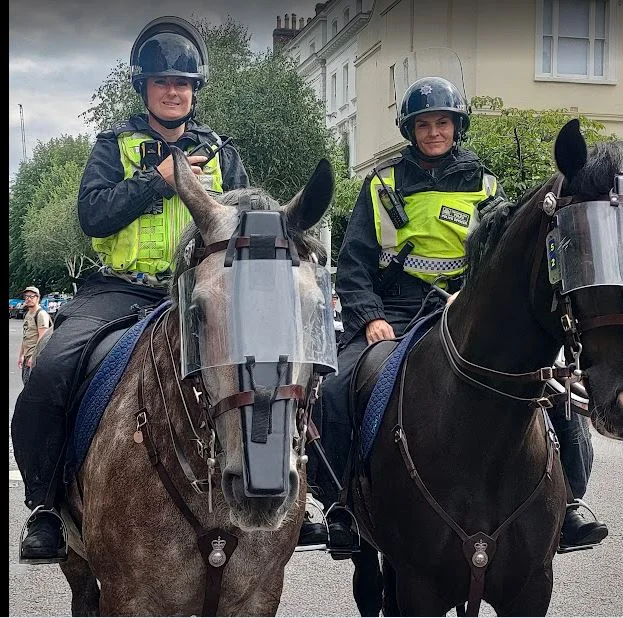
Finally, the overall cost of Carnival to the Met is reportedly approaching £11,800,000; this is a figure that has been particularly noted by those officers who are about to lose their dogs and horses which are hugely valued across the Met’s front line.
There is much shaking of heads with the closure of the esteemed Royal Parks unit of the Met. Schools’ officers, initially welcomed with suspicion by many within the teaching profession but who became valued colleagues have also gone. These are but two examples as other departments and sections wait to hear their fate.
Linked to the dismay across the rank and file, there is positive anger at the proposed cutbacks to the dog and mounted sections and the treatment of officers who have worked so hard with their animals and who now are uncertain of their fate and that of their much- loved animals.
Finally, of course, there is the constant denigration of the Met by both social and the mainstream media and what is perceived to be a lack of ‘pushback’ by the Met although there are signs that there are some green shoots here. The use of body-worn camera footage to illustrate outstanding work is now becoming more prevalent. This progress, however, is obviated by the perception that those at the top of the Met, like their predecessors, have simply rolled over and waved their legs in the air when faced with a lack of funding that will have a detrimental effect on both the organisation and the public it serves.
As I stated at the start of this piece the issue of low morale and the atmosphere of uncertainty could have affected the performance of Met officers during Carnival. The simple answer is that, despite the long hours and hot weather, it didn’t.
Chris Hobbs is a former Special Branch officer who follows public order events for Police Oracle.
Another carnival of mayhem and chaos over. No murders, only 2 stabbings and a huge number of arrests which I suspect along with the use of LFR reduced the ability of the untermench to cause carnage.
Yet another year with no mass casualty event but sadly with the numbers attending it will only take one incident to cause a stampede and I do wonder how many dead it will actually take before this obscenity is banned.
Thousands of “ carnival crimes “ are committed and not flagged because they fall outside of the Carnival area.
I worked Carnival this year and it was as described – there does seem to have been a change in the support we receive from those who attend. People do now seem to want us there, do want us stopping and searching, do want us arresting, do want the knife arches and facial recognition. There was a feeling of safety and an absence of that usual mood-shift. Glad to see less violence at this event.
Advertisement
Job of the week
Firearms Range & Accreditation Manager

- Merseyside Police
- OCC Speke
- Grade E – £33,603–£39,276
Are you an experienced firearms professional with a passion for maintaining the highest standards of safety, training, and operational excellence? We are seeking a dedicated Firearms Range & Accreditation Manager to take responsibility for the daily management and compliance of our College of Policing–approved firearms training complex. This is a pivotal role within Matrix Operational Support, offering the opportunity to shape the quality, safety and accreditation standards that support our specialist firearms capability.
Read moreCoffee break