Article
Eyewitness: Ukraine versus Russia conflict manifests itself in Holland Park

Chris Hobbs attends a Russian/Ukraine protest and some May Day events that took on another protest outside Charing Cross Police station.
It was a microcosm of an ongoing conflict that has had and is having worldwide repercussions but was taking place in Holland Park. On one side were a small group of individuals with some carrying Russian flags. They were separated by a road and several police officers, from an equally small group of those carrying Ukrainian flags who were standing outside the Ukraine Embassy.
The occasion was an anniversary of an incident back in 2014 which occurred in Odessa when there was serious rioting between pro-Russians and Ukrainian nationalists. 48 people reportedly died, 46 of whom were from the Russian side.
In fact, on this occasion, the numbers on both sides were just enough to form two football teams. The Met were clearly caught unawares, as a police carrier with several local officers arrived on ‘blues and two’s’ having been hurriedly scrambled. They were joined by two diplomatic protection officers.
The two groups exchanged insults across a very quiet road with one individual on the Ukrainian side tending to dominate proceedings with his stentorian tone. The Russian side held a meeting with one individual using a week sound system that didn’t extend beyond that group. Given the ongoing conflict it was surprising that the turnout on both sides could only be described a meagre.
I had intended to make my way down to the Iranian Embassy where there was yet another Iranian linked rally but became unwell and had to hail a taxi to get me home. I later discovered that there had been fisticuffs between Kurdish protesters and Iranians, though I hadn’t been able to establish whether the latter were pro-monarchist or pro-regime. The Kurds don’t see eye to eye with either group.
London’s May Day rally
After a day of rest, I decided to give myself a ‘fitness test’ and attend the normally uneventful May Day march and rally in London which began at the traditional meeting point of Clerkenwell Green before proceeding to Trafalgar Square. Union banners were much in evidence as were red flags but there was a surprising lack of visible support for the Palestinian cause.
All seemed in order with the march being led by a band and the head of the march reached Trafalgar square without incident, other than one individual dropping a red flare which caused choking clouds of red smoke.
However, as the march continued to enter Trafalgar Square, I noticed police officers running back up the Strand. I followed and found a police cordon forming across a narrow side road which then faced an angry crowd. It would appear that arrests had been made.
Most of those facing police were young and a number were masked. There then followed predictable chants of ‘Let them go,’ and ‘shame on you.’ The march had stopped although most marchers didn’t join the baying crowd.
After a while a march organiser announced to the crowd that the prisoners had been taken to a police station and that the protesters and marchers should join the rally in Trafalgar Square where the speeches had already started.
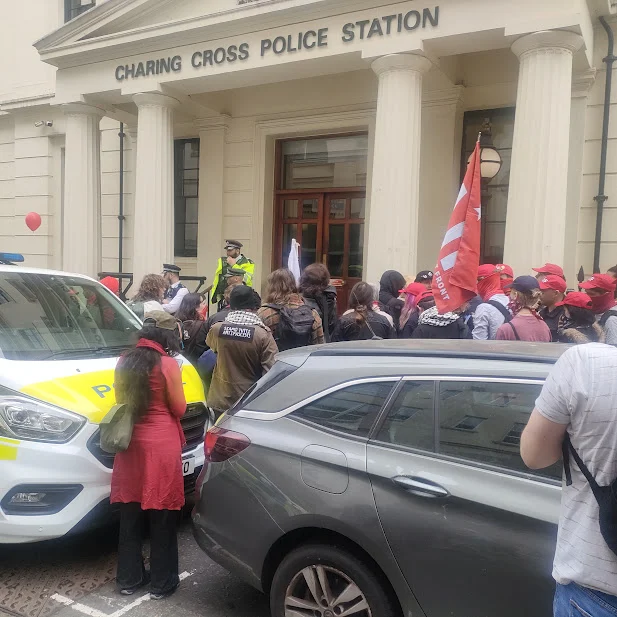
The speeches held little interest for the group who confronted police; they formed up again and marched to Charing Cross Police station where, amongst their chants was ‘free, free the Mayday three.’ Watched by a number of officers they vowed to wait until their compatriots were released. They would have had a long wait; the ‘Mayday three’ had been taken to another London police station.
The talk amongst officers on the day was primarily the protests which are now less than two weeks; namely the Tommy Robinson ‘Unite the Kingdom’ event and the pro-Palestinian NAKBA and anti-racist counter protest, both of which are expected to attract large crowds accompanied by a huge, expensive policing operation in order to keep the two sides apart.
There was also amusement amongst those on the front line concerning the frequent use of the term, ‘extra’ officers following the Golder’s Green incident.
Chris Hobbs is a former Special Branch officer who follows protests as an observer for Police Oracle.
Category: Public Order
Advertisement
Job of the week
Lead Investigator and Crime Manager – British Indian Ocean Territory
- British Indian Ocean Territory Police Service
- Diego Garcia, British Indian Ocean Territory (BIOT)
- £55k to £65k
Looking for a policing role that's different from anything else in the UK? The British Indian Ocean Territory Police is seeking an experienced Police Sergeant (Crime Manager & Lead Investigator) to join its team on Diego Garcia.
Read moreCoffee break