Article
Eyewitness: ‘I pay your wages’
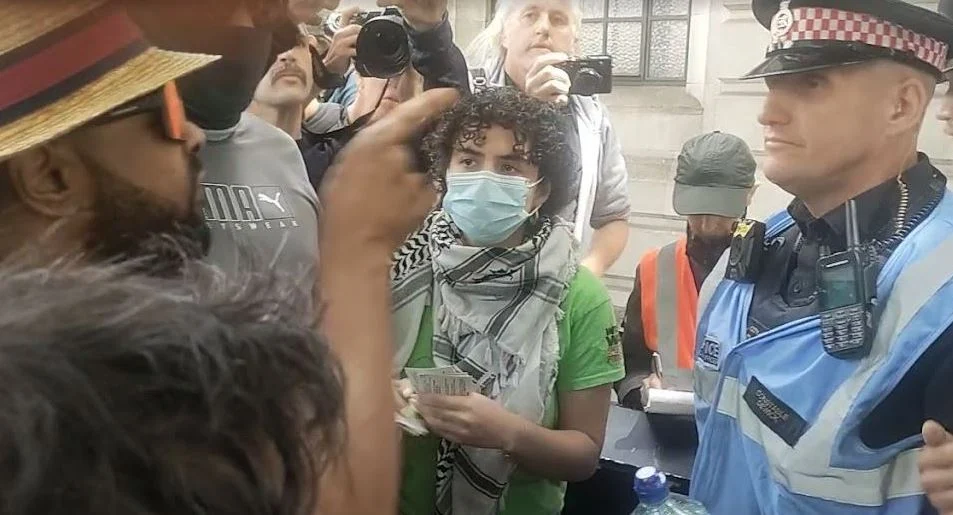

Chris Hobbs who follows protests as an observer for Police Oralce, highlights a growing trend in which officers are subject to verbal abuse and intimidation.
After the drama, largely unreported, of a stabbing at a Whitehall pro-Iranian regime rally and counter-protest, the public order situation in London was relatively uneventful across last weekend. There was controversy however and this came in the format of social media footage which showed a protest just days earlier in North London.
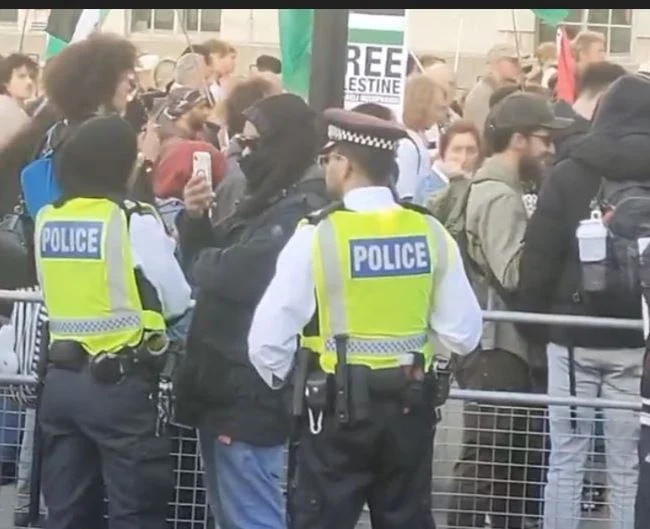
Almost inevitably the protest concerned Palestine. The difference, on this occasion was that the line of police included a female Muslim officer in a hijab. The footage clearly showed her receiving ‘in your face’ abuse from passing pro-Palestinian protesters. As the police line moved off, male officers could be seen forming a protective shield in front of their colleague.
I understand that the officer is receiving support from the Met.
Not an isolated incident
This situation is not an unfamiliar one. Just days earlier, at a Whitehall pro-Palestine protest, I saw a masked male work his way around the barriers and confront a female officer who was also wearing a hijab. Whilst I couldn’t hear what was being said, the conversation took place with the masked individual filming the encounter or, to put it another way, by ‘sticking the phone in her face.’ The officer in question was steered away by colleagues.
A few months ago, a pro-Palestinian march finished with a rally by Downing Street. This meant the closure of Whitehall with the result that thousands of protesters were milling about. Shortly after, a female hijab-wearing Met officer took to social media to complain bitterly about the abuse she received from pro-Palestinians.
It is not just hijab-wearing female Muslim officers who are receiving abuse. Again, during a pro-Palestinian march, a police cordon was placed across a side-road off The Strand. Amongst the officers was a young turban-wearing Sikh officer. He too became the target of abuse.
Whilst the above incidents refer to Asian officers, six years ago I wrote an article which featured the trials and tribulations of black officers in both the UK and the USA. The article in question was triggered by specific incidents that featured two officers.
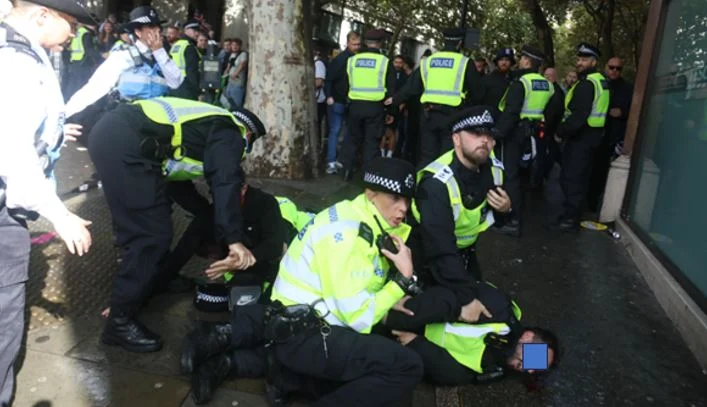
Recently, there was a Palestine Action ‘arrest me,’ event in Trafalgar Square where more than 500 individuals were arrested by police for showing support for the proscribed organisation. The Met requested aid from a number of forces and one of these ‘aid’ officers was recognised as being a ‘Palestinian DJ;’ a reference to a part-time hobby. He too was harassed by a number of female protesters, but clearly an experienced officer, he responded with commendable, smiling aplomb.
A feature of policing protests these days, is the use of ‘Police Liaison Officers’ in their distinctive sky- blue tabards. In the Met, the best-known liaison officer is Asian and can be frequently seen at pro-Palestine protests. He is well respected by most on both sides of the political divide, but despite this he is the frequent recipient of racist abuse.
Future events and ‘in your face’ abuse
On May the 16th, there is a Tommy Robinson ‘Unite the Kingdom’ march and rally’ in central London which will be opposed by a large number of pro-Palestinian/anti-racist activists; this in turn will create a very real threat of Asian officers, especially hijab wearing females, being vulnerable to abuse from both sides.
Linked closely to this issue, is that of ‘in your face abuse’ of police officers. This can most frequently be seen on Friday and Saturday nights as police try and deal with violent situations perpetrated by those whose behaviour is influenced by drugs or excess alcohol. However, this can also be seen during the day and during protests with those screaming foul-mouthed abuse confident that there will be no repercussions.
This in-your-face abuse can be frequently be viewed on police fly-on -the- wall documentaries and even where an arrest is made for a public order offence, the results section at the end of the programme all too frequently shows ‘no further action,’ even though offences are clearly seen earlier as the arrest is made.
Another form of abuse linked to another pro-Palestine protest concerned ‘in you ear abuse.’ This wasn’t verbal abuse, but the banging of a steel pot within a couple of inches of an officer’s ear that continued for twenty minutes. There was no comment from the Met but word amongst officers was that some form of damage was caused involving tinnitus. Hopefully, if the rumour was true, it was temporary. The banging of steel pots was to symbolise the hunger of the inhabitants of Gaza.
Then and now
Officers of my era would not have tolerated being abused by foul mouthed thugs. Normally it would have been one or perhaps even two warnings but a failure to comply would result in an arrest.
These days, the Crown Prosecution Service, magistrates and judges have deemed that police officers should be ‘more robust’ than members of the public and less likely to suffer ‘harassment, alarm or distress’ as a result of abuse. These constraints upon police powers of arrest, can be found on the websites of UK solicitors across the country and are mirrored in AI responses.
Posing a question to Google or another AI service along the lines of; ‘why do police in the UK appear to tolerate being abused and sworn at without making an arrest?’ will provide further detail.
These constraints placed upon officers have thus now become enshrined in our legal system to the extent that those so inclined can abuse officers at will. However, it is surely hugely relevant that officers are currently being assaulted in record numbers and a frequent precursor to such assaults is unchecked foul-mouthed abuse. It surely follows therefore, that officers being abused will suffer ‘alarm or distress’ in anticipation of a possible assault which in turn would surely justify arrest.
Auditors and pseudo journalists
Another issue concerns so called auditors who initially appeared content to loiter in the vicinity of police stations and provoke police officers by asking generally inane questions hoping to provoke a response which will earn them ‘clicks’ on social media. These individuals have expanded their activities and now can dog the footsteps of officers at any time, thrusting cameras and phones into their faces, again trying to provoke an injudicious response which will again result in clicks and a possible complaint against the officer.
One individual pursues Met officers who he believes may be sporting the thin blue line patch which the Commissioner controversially banned after complaints from minority groups. Other forces permit and even encourage officers to publicly wear this patch on their uniforms.
Another, with his mobile phone was seen, by me, walking along a police cordon during a protest in Parliament Square demanding that each officer showed him their warrant cards to prove they were ‘real’ police officers.
Closely linked to auditors are those activists who have given themselves the label of ‘journalist’ and who demand their ‘rights’ as such. Little wonder that on protest days, officers less experienced in service, view with justifiable suspicion, any adult male who approaches them. On a personal note, I found myself referred to on the web as a ‘freelance journalist’ which, perhaps somewhat unfairly, I regard as quite insulting.
A UK Halo Law?
One solution that has been discussed in policing circles in an attempt to obviate the issues referred to above, is the introduction of a ‘Halo Law’ which has recently been introduced in some American states. The enables first responders, which includes police, firefighters, paramedics and emergency medical technicians, to create a 25- foot buffer zone around the incident they are dealing with.
This is imposed in order to prevent interference, threats or harassment by the public and breach of it renders the individual liable to arrest. Where this Halo law has been enacted in the USA, the errant, arrested individual could face a fine or even imprisonment.
Legislation could be adapted to include crime scenes where, thanks to improved forensics, officers have frequently to stand guarding the cordoned off area for hours. This can result in those officers having to endure abuse from members of the public who either have to comply with diversions or simply don’t like police.
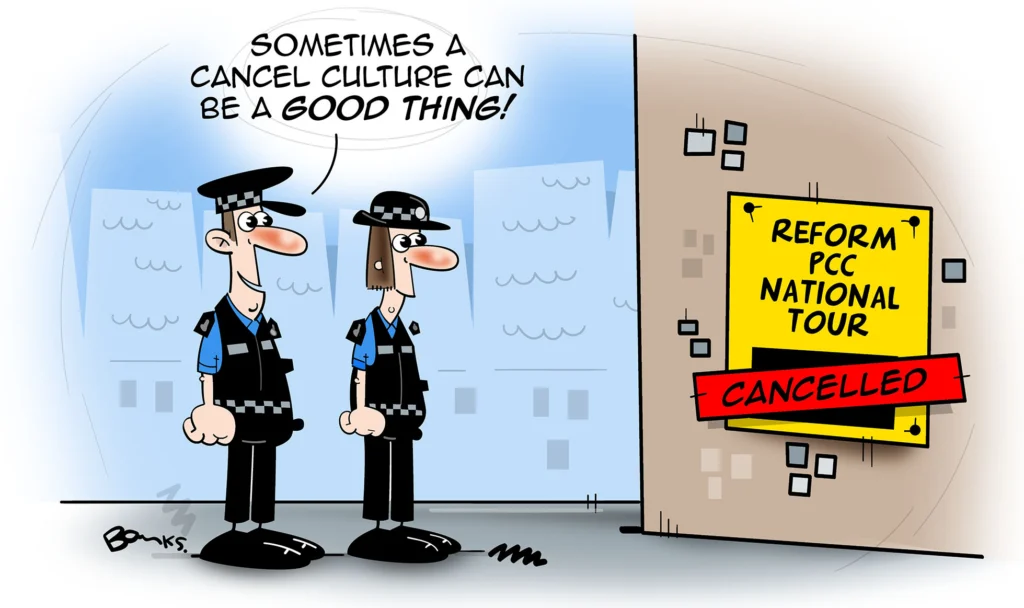
There have been suggestions that the in- your- face abuse of police officers should be made a specific offence and there is a petition to that effect. Recent events at Epsom perhaps illustrated the need for such legislation; however, inertia exists amongst most senior police officers who have long since lost touch with the realities of the front line. This means that a joint response that could jolt politicians into taking action, which would, in turn, protect officers and other 999 responders, is unlikely.
Poorly led punchbags
In the meantime, officers, believing they are poorly led punchbags, are haemorrhaging out of the police service. In the Met, the majority of front- line response officers now have less than five-years-service while the most recent staff survey showed that 51% of officers who responded intend to leave or are thinking of leaving. Many officers don’t in fact, complete the survey as they don’t trust its anonymity. That figure may well increase given the Met’s controversial use of Palantir, a US-based software company, to impose what many regard as ‘intrusive surveillance’ upon its workforce. It is already being dubbed ‘Horizon 2.’
Chris Hobbs is a former Special Branch officer.
Category: Public Order
Advertisement
Job of the week
Lead Investigator and Crime Manager – British Indian Ocean Territory
- British Indian Ocean Territory Police Service
- Diego Garcia, British Indian Ocean Territory (BIOT)
- £55k to £65k
Looking for a policing role that's different from anything else in the UK? The British Indian Ocean Territory Police is seeking an experienced Police Sergeant (Crime Manager & Lead Investigator) to join its team on Diego Garcia.
Read moreCoffee break