Article
Eyewitness: hotel protests continue as a resurgent ANTIFA take to the streets

Chris Hobbs continues to track the recent surge in protests based around asylum seeker hotels.
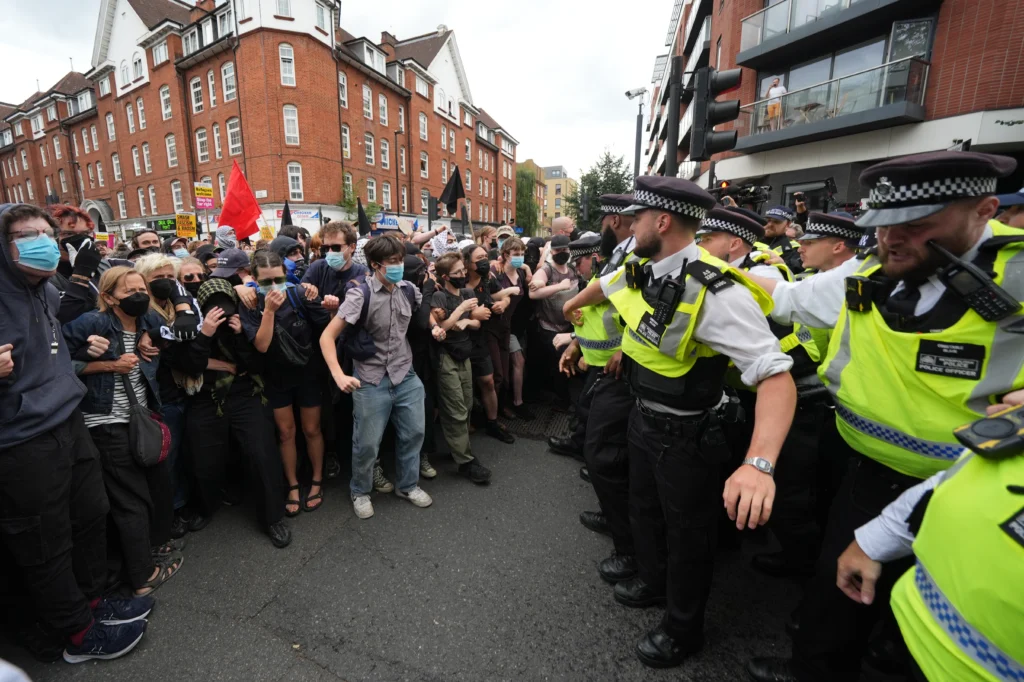
Only around the back streets of that part of Islington that borders on the City of London, was the size of the Met police operation evident. Police carriers were tucked away and many officers were clearly ‘kitted.’ I’d been warned, as I was walking up to the protest, that the leftist turnout opposing those who were demonstrating against a ‘migrant hotel’ would be greater than normal and that the largely moribund ANTIFA would be making a comeback.
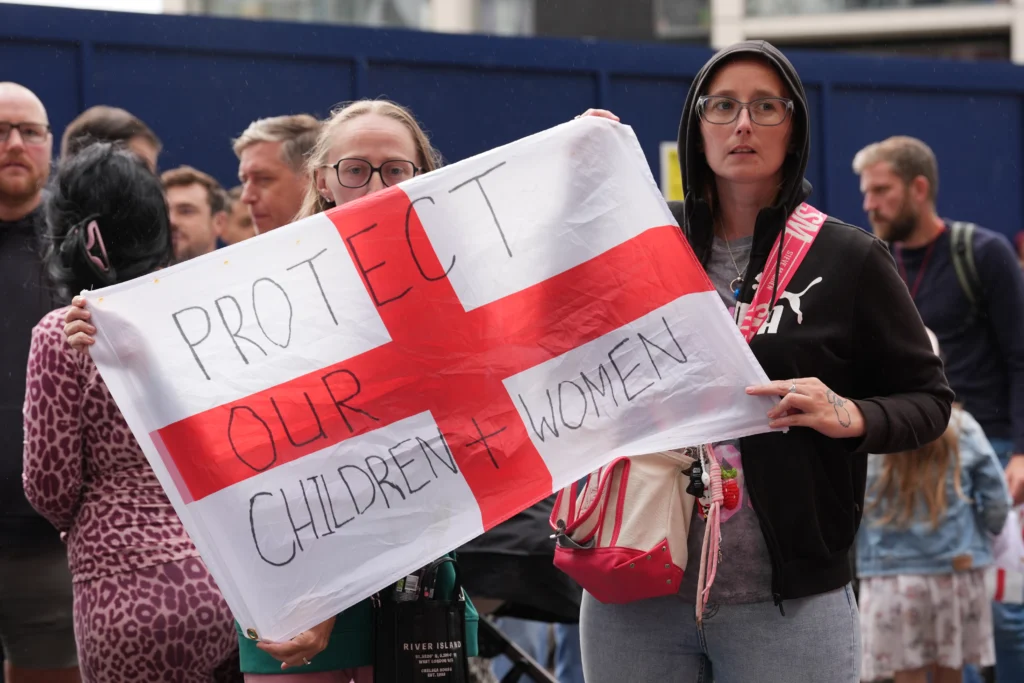
The Stand up to Racism (SUTR) protesters were already in place in their designated area and assembling diagonally opposite in a small shopping precinct were the anti-migrant protesters. The Thistle Hotel was literally within throwing distance of both designated areas. As I walked up past the SUTR contingent, I was informed that ANTIFA were gathering elsewhere.
Locating them wasn’t difficult; they numbered around 200 and many were masked. They were being briefed in terms of what to do if they were arrested. This was an interesting development; ANTIFA had, over the past few years, virtually disappeared as an entity. Their last appearance in significant numbers in London was several years ago when they blocked a DFLA (Democratic Football Lads Alliance) march. They haven’t been evident where there have been counter-protests at more recent Tommy Robinson rallies and other events deemed ‘far-right.’ At the last ‘for our children’ protest which was also dubbed ‘far-right’ by SUTR, barely 200 anti-racist protesters materialised at the Parliament Street end of Whitehall.
Section 14 flouted
SUTR protest but didn’t join the several hundred or so in the designated area. Instead, they marched into the crossroads by the hotel and made it clear that this would be where they would remain thus breaching conditions imposed by police as laid down by Section 14 of the Public Order Act.Police then moved their carriers parking them across the width of the road which effectively blocked the views of the rival groups from each other. A handful of anti-migrant protesters attempted to ‘join’ their rivals but were easily frustrated by officers.
The question then remained as to police action concerning the errant anti-racist ANTIFA activists. Initially, City of London police moved into the group which resulted in some pushing and shoving before they withdrew. Thus, it appeared a more determined approach was needed. Further officers arrived who were ‘kitted’ and various cordons were formed. By this time migrants had appeared at several hotel windows and were exchanging cordial greetings with the both groups of anti-racist protesters.
“Snatch squads”
As events developed, a serial of Met officers, in their day uniforms, formed up and suddenly made a rapid incursion into the ANTIFA group who predictably resisted. Initially it was believed they were attempting to break up the protest but after they withdrew, it became apparent that this was not the case. ‘Kitted’ officers forming cordons moved to assist their colleagues but were ordered to remain where they were.
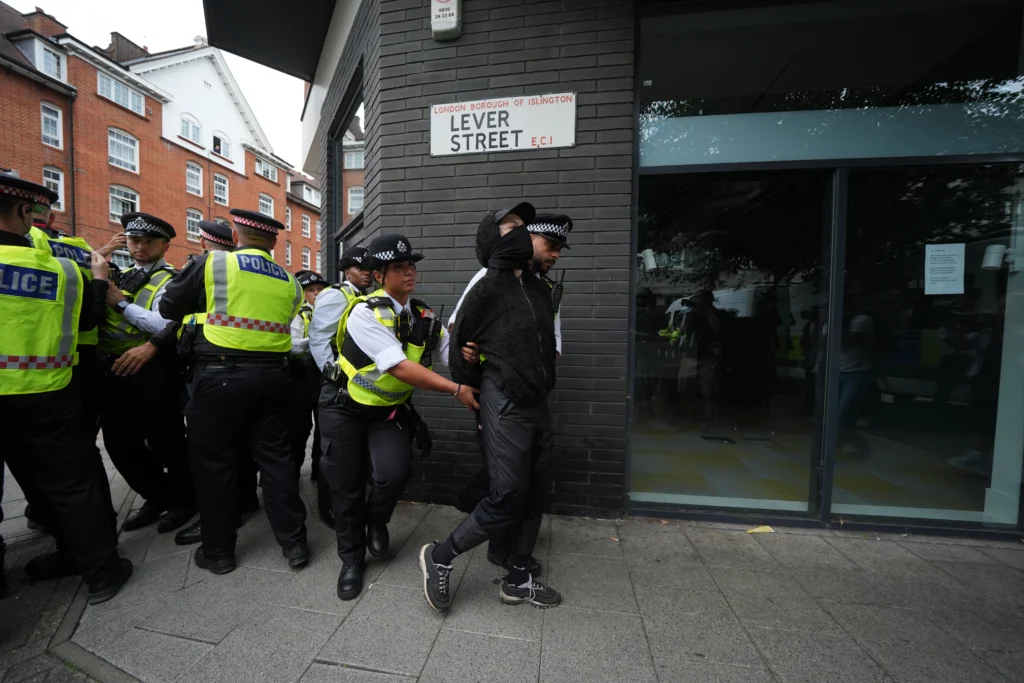
The second attempt brought about a realisation as to what these officers were trying to achieve; each individual in that ANTIFA group were clearly breaching the conditions of the counter-protest and these officers were in fact acting as ‘snatch squads.’ ANTIFA’s defence bore some resemblance to the 19th century British army square. They grouped closely together linking arms in a tightly packed formation thus making it difficult for the officers to achieve their objective.
All involved with ANTIFA were clearly flouting the conditions imposed upon them and were therefore arrestable. The forays of police involved more than a degree of force with punches and kicks a feature; surely however, even the most hostile ANTIFA activist would admit, the level of force used against them was marginal as opposed to that which would have been inflicted by police forces across Europe.
Police emerged with their prisoners on several occasions before a halt was ordered. Interestingly to those of use who were seasoned observers, it was officers in their ‘day uniforms’ who formed the ‘snatch squads’ rather than those officers dressed in public order kit. Those in their day uniforms looked younger and slightly more apprehensive that their public order ‘kitted’ colleagues who had maintained cordons around the contested area. These observations could have simply have been the result of over-imaginative speculation but in any event the ‘snatch squads’ acquitted themselves well without needing to resort to batons and short shields.
The arrival of the TSG
After several forays by police there was a lull in proceedings during which I suggested that perhaps this was a situation that required the TSG. I was informed that they were ‘on their way’ and indeed minutes later the familiar dark blue carriers appeared in view of all. Officers alighted in the familiar public order kit but without helmets. They formed up and other officers cleared journalists and photographers out of their path thus giving them a ‘clear run’ to the ANTIFA group who had changed their formation so that their front line was facing the TSG.
Everyone expected a dramatic foray into the ANTIFA group but in fact officers walked casually and not in any sort of formation, to the ANTIFA activists and engaged them in conversation. A number of these ‘engagements’ took place and after a few minutes the ANTIFA group made their way towards their SUTR allies and through the barriers into their designated area thus complying with conditions.
Minutes later, via a megaphone, the anti-racist activists were given their dispersal directions by the organisers; the most important section being that they would leave together. They then turned around and left the venue in a large group followed by Met officers. After a few minutes the vehicles being used as barriers across the road were moved while police liaison officers moved unobtrusively amongst the counter-protesters reminding them of the 4PM witching hour in what was a relaxed atmosphere.
This would have come as a relief to a female officer medic who had tickets for Oasis that evening.
The Met later stated that there had been nine arrests during the course of the protest and counter protest.
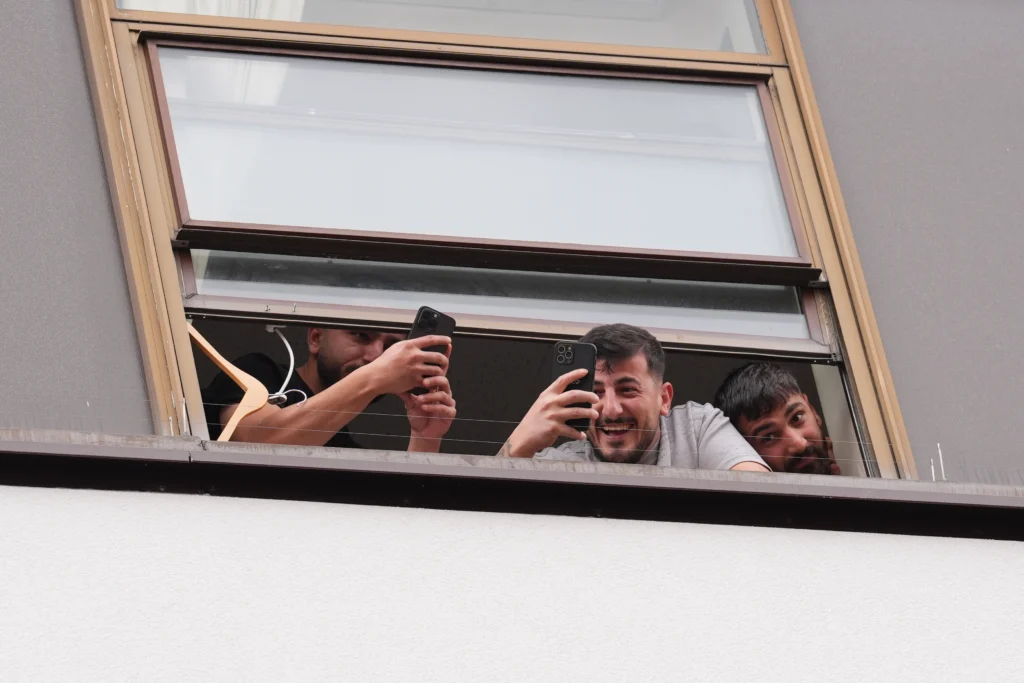
Elsewhere across the country there were, across the country, further protests against the housing of migrants in hotel including one in Manchester that reportedly attracted 1,500 protesters amidst a plethora of Union and St George’s Cross flags.
On Sunday, another migrant related protest was held in Canary Wharf outside the Britannia Hotel involving women and children sitting in the road. Police gently suggesting they move attracted the ire of those on the right of the political spectrum. Those same individuals would doubtless have aimed furious criticism at the Met if officers hadn’t arrested pro-Palestine protesters who blocked traffic in Oxford Circus on Friday evening. Their main theme was the suffering of children in Gaza.
Later at Canary Wharf, police later issued harassment notices which effectively banned this group of protesters from the areas for 28 days. Other protests, however, would still be permitted. This led to social media accusing the Met of banning all protests at the hotel for the 28 day period. The Met issued a clarification but like the false claims in respect of the ‘bussing in’ of anti-racist protesters at Epping, this misinformation is now set in tablets of stone.
Further misinformation, that migrant hotel residents were leaving on ‘e’ bikes to illegally ‘go to work’ was also corrected in that these individuals were simply delivering and indeed, were prevented from doing so.
There were also further reports that about thirty masked men ‘crashed’ the peaceful demonstration and attempted to enter the hotel as well as setting off flares. One man was arrested.
Issues
Two issues emerged from Saturday’s Islington protest which would be applicable to others. Many ANTIFA protesters were masked and the question was posed as to why Section 60AA, forbidding the wearing of masks, wasn’t invoked as it had been in Epping last Sunday.
The other issue is one of communication: Informing protesters that they are breaching a section of the Public Order Act or that another legal requirement is being imposed, such as in respect of masks or a dispersal order, surely cries out for the use of a megaphone. I’ve seen this used just once, at an early pro-Palestine protest at the Israeli Embassy and it was extremely effective.
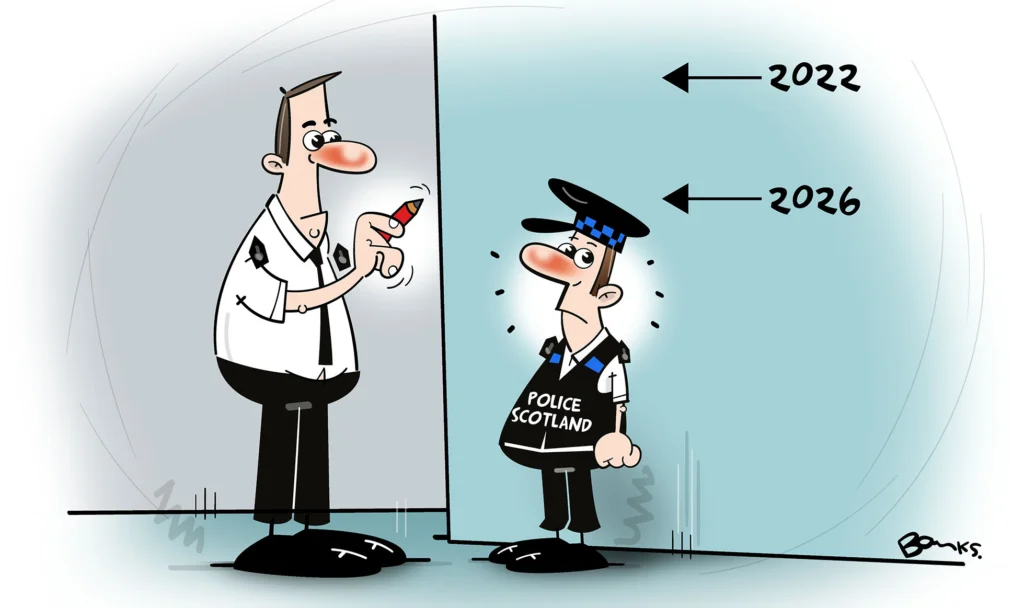
At this moment in time, the country seethes with discontent amidst recent reports of clashes between rival groups away from London. Meanwhile, details and rumours in respect of Met cutbacks and tenure, be they accurate or otherwise, continue to circulate; this surely is less than desirable at a time when rapidly diminishing morale could be a crucial factor as the tensions referred to above, result in more public order challenges for the policing front line.
Chris Hobbs is a former Special Branch officer who follows public order events as an observer for Police Oracle.
Category: OpsPublic Order
“Take to the streets” or aboard Essex Police carriers?
Advertisement
Job of the week
Anti-Corruption Investigation Officer

- HM Revenue & Customs
- Croydon, Manchester, Nottingham
- £31,096 - £37,919.
Discover what it’s like to work in a compliance role that makes an impact. Could you help us shape a stronger, fairer future? Your next career move starts here. Are you ready to take the next step in your investigation or intelligence career—within an organisation that places integrity and public trust at its core?
Read moreCoffee break