Article
Sponsored content: Predicting the Protest – is Proactive Policing the Future?


By Daniel Locke, Tadaweb.
Is Policing ready to move with the times and become proactive rather than reactive when looking at managing and identifying protests and disorders? This has been a recurring question since I was a serving officer, and it continued when I joined Tadaweb, a company whose mission is to help analysts and officers transform publicly available information into real, actionable insights. The publication of the HMICFRS Tranche 2 report continue to highlight the topicality of this issue.
A history of reactive failures
Historically, Policing has relied on traditional forms of intelligence collection relating to planned protests and disorders. For a long time, it was enough. In 2011 this changed. The large-scale disorders seen that summer across London and beyond live long in the memory. For the first time, social media was used at scale to fan the flames and organise locations for gatherings. The subsequent HMIC report showed that, even though the right technology was available, social media monitoring was not done consistently, although there were some pockets of good work.
Fast forward to the summer of 2024 and the tragedy in Southport. The spread of information on social media sparked unrest and disorder across the country.
Another HMICFRS report followed, criticising the police for not understanding the online space and failing to act on the 2011 report, it called for a change in the way online information was used and viewed.
In 2025 we saw a marked increase in activity by multiple activist groups, notably tied to Palestine Action, or anti-migrant groups. All of them used online platforms, both traditional (such as Facebook) and non-traditional (VK, Telegram etc.) to organise.
This raises a fundamental challenge, as identifying protests that are likely to escalate is as complex as making sense of the data that can be collected. It also requires a shift in mentality to be more proactive, as reactive policing is what officers are mainly trained for. But, what if Policing fully utilised existing technology to get ahead of the curve using publicly available information?
Tadaweb, a platform for a proactive approach
Imagine the following example: Force X has been targeted by group Y previously and is likely to be a target again. Y group are known to use social media to communicate and organise activities. These will often start as lawful protests but turn into disorders.
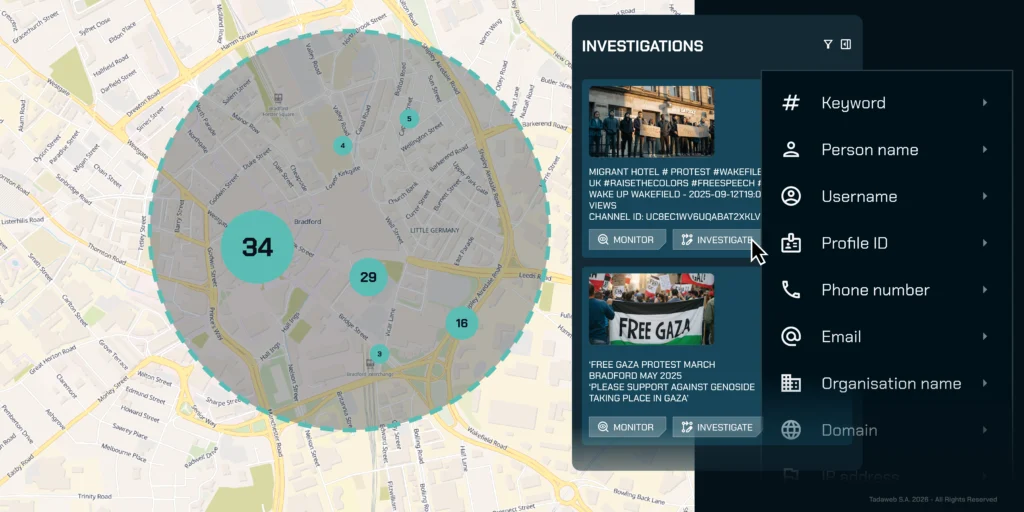
Following a robust methodology, embedded into a dedicated platform, can help you make tremendous efficiency gains. Tadaweb helps you to do so easily and with confidence, by automating your collection and assessment process. Starting from our secure browser, you can identify keywords, selectors and websites of interests, then pivot to social media and relevant online communities to map potential threats. Once the initial threat assessment into group Y has been done, you can review public posts and events to anticipate violent activities, and ensure preventive monitoring based on multiple inputs, including geolocations. Any information of interest can then be saved to evidential standards, and you can iterate on your intelligence collection cycle within a single centralized space.
Working in this way you are already thinking in terms of objectives whilst verifying information at each stage. This approach leads to minimising the volume of data collected whilst maximising its relevance. Below are some examples on how I have implemented this approach.
Example 1: Proactive disorder prevention
Prior to their proscription Palestine Action were THE perfect example of an organised activist group who used social media to arrange protests/action/disorder around the country. With the amount of media attention the group was receiving I set out to pull back the curtain on the group. My objectives were simple:
– Identify the hierarchy and any publicly available information and selectors
– Identify potentially relevant locations
– Identify sub/affiliate groups
– Monitor publicly available information to identify planned activities most likely to escalate
– Pass on intelligence received to Policing to allow proportionate response
Using Tadaweb, I was successful in achieving these objectives with the outcome being:
– New information relating to the hierarchy and their whereabouts.
– Identified multiple physical locations the group were vocal about targeting.
– Mapped sub/affiliate groups across much of the UK.
– Identified planned activity for the future in many areas.
– Created an automated collection plan to identify any further changes to locations.
Example 2: Attribute criminal acts and prevent further disorders
July 2025. A hotel used to house asylum seekers was targeted by a large group of people following reports of sexual assault.
My objectives were to:
– Monitor the location and identify posts of interest.
– Identify those involved in criminality.
– Identify any future planned activity likely to escalate.
– Identify any risk to the public.
Using Tadaweb, I was successful in achieving these objectives with the outcome being:
– Identification of multiple posts of interest giving keywords and hashtags to search further.
– Identified videos showing criminality taking place. Saved evidentially.
– Identified planned protests likely to escalate for the following weekend.
– Mapped the spread of this across non-mainstream media.
– Identified counter protest planned for same location and the same time.
On reviewing the data collected it became clear that the spread of information went further than the ‘traditional’ social media of Meta and into VK (Russia affiliated, right wing parties) and Bluesky (left wing parties) to name two. Creating a balanced collection plan to monitor both sides of the divide allows Police to identify community tensions, sentiment towards protests and those involved, along with sentiment towards asylum seekers in the local area.
Conclusion
This shows that proven intelligence methodologies coupled with a powerful OSINT platform such as Tadaweb are key to tackle an area in which Policing has come in for a lot of criticism over the last decade and a half. Taking a more proactive approach to understanding the problem and using targeted data collection strategies, policing COULD start to rectify those recommendations which have loomed large for the last 15 years and transform itself into something that is fit to tackle the ever-growing challenge that is the online domain.
These use cases show that both a purely proactive or, a reactive into proactive intelligence approaches are possible to inform decision making. To make it concrete, ambition and education are key. There are so many officers/staff who excel at online investigations. There are equally as many who do not fully understand the potential impact it can have, time it can save and efficiencies it can drive.
Tadaweb offers an answer: designed for intelligence professionals, it embeds proven OSINT methodologies and sources for intuitive investigation and comes with training and support.
The only thing holding Policing back is investment and a willingness to work with industry. For more information visit: www.tadaweb.com
There is also a webinar on February 24 explaining how the technology can help: click on this link
Category: Advertorial
Advertisement
Job of the week
DEPUTY COMMISSIONER OF POLICE

- Royal Cayman Islands Police Service
- Cayman Islands
- CI $121,356.00 – $155,316.00 per annum
The Deputy Commissioner of Police provides strategic leadership in support of the Commissioner of Police to ensure the effective management, direction, and oversight of the Royal Cayman Islands Police Service (RCIPS). The role is critical to advancing national security, enhancing public safety, and sustaining public trust across the Cayman Islands. The post holder is responsible for leading the development and execution of policing strategies, overseeing operational and organisational performance, and ensuring compliance with legal, ethical, and professional standards. The Deputy Commissioner also serves as the principal liaison with government entities, community stakeholders, and international partners, and assumes full command responsibilities in the absence of the Commissioner.
Read moreCoffee break