Article
Eyewitness: the thin blue line of two and talk of sinking morale

Chris Hobbs witnesses commendable work by two PLOs at a protest and then drama outside the MOD.
As I walked down the Strand towards Aldwych, I could hear the chanting from protesters which I knew was in relation to the London Defence Conference that was due to take place at Bush House; this event was linked by pro-Palestine activists to the current conflicts in the Middle East.
When I arrived, I could see the pro-Palestinian and pro-Israeli groups facing each other with both doing a passable impression of rival football fans.
It occurred to me that one crucial element was missing from this scenario and the penny soon dropped; it was the police or rather the lack of them.
Instead, around 100 pro-Palestinians were confronting about 60 pro-Israeli activists watched by intrigued passers-by.
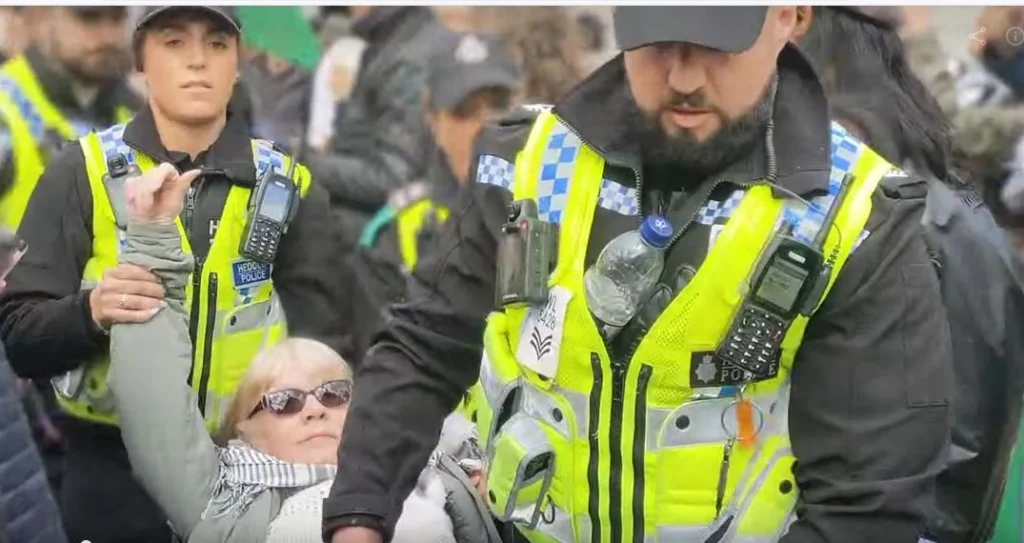
I was about to dial 999 when I saw two police liaison officers (PLOs), distinguished by the sky-blue tabards, appear at the rear of what was turning into an increasingly agitated confrontation. One officer was talking into her phone and radio as the situation became tenser.
Both groups began inching towards each other as if plucking up the courage for confrontation and eventually they did meet which led to angry exchanges: Immediately the two PLOs intervened breaking up several potentially violent incidents.
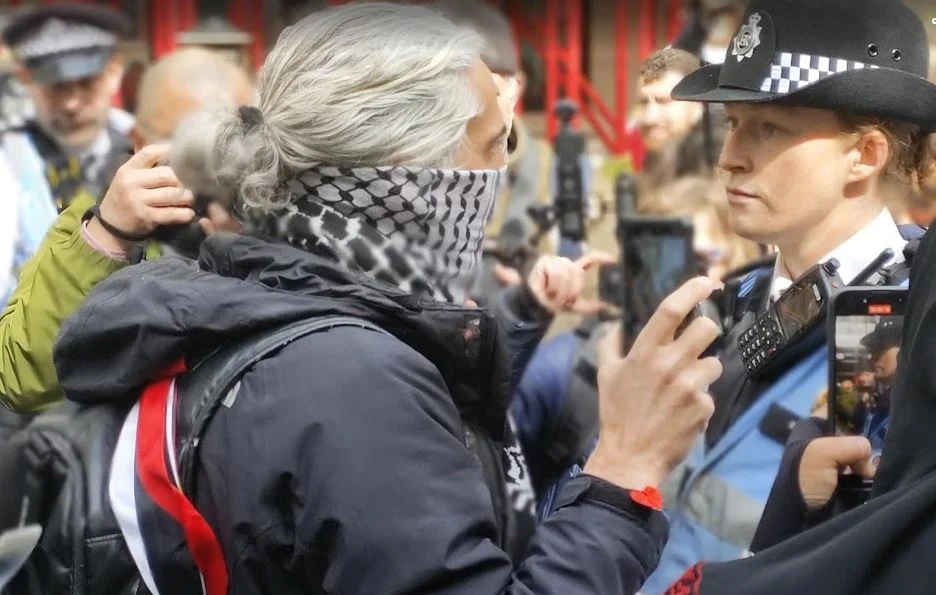
After about twenty minutes a police carrier arrived with one sergeant and seven PCs alighting to assist the two officers already present. However, almost immediately the pro-Palestinians began moving out of the Aldwych area after forming up and taking to the road thus blocking traffic. They made their way onto the Embankment by the Thames blocking the westbound lane. The two PLOs caught up with the noisy group and were later joined by officers from the carrier.
At any moment I expected to hear the sound of sirens as additional police officers rushed to assist but there was no further police intervention.
Eventually the group plus the handful of officers reached the rear of the Ministry of Defence (MOD) building and made their way on to Whitehall via the alley that runs between the MOD and New Scotland Yard. Once on Whitehall, the chanting marchers, without blocking traffic, reached an anonymous building where they stopped and continued chanting. This puzzled the watching press and observers including myself. It was subsequently revealed that this is the headquarters of the Royal United Services Institute described as ‘the world’s oldest independent defence and security think tank.’ Clearly the march organisers had done their homework.
They then moved up Whitehall and stopped outside Raffles Hotel which again puzzled the journalists and observers. Clearly the protesters had better sources than we did as it later transpired that the conference had been moved to Raffles as the original venue was deemed too small.
Raffles placed a couple of security staff in front of the doors which were later closed. In the interim protesters attached stickers to the walls and the closed doors before they then moved around to a back entrance.
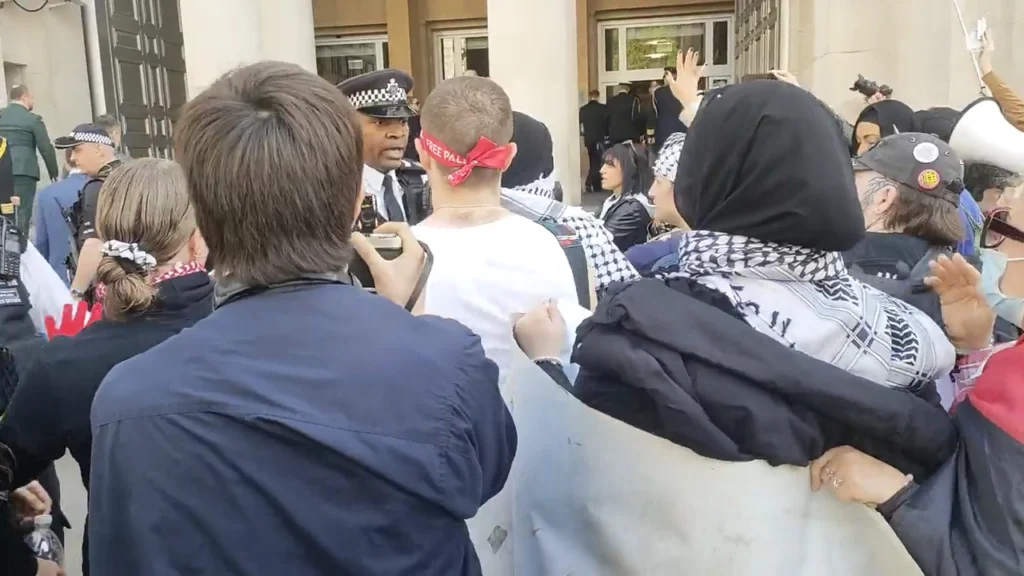
Military officers menaced by protesters
The protest looked to be coming to a close when suddenly and dramatically, the activists became galvanised. It soon became obvious why; walking across the road, about 50 metres from the protest were a group of senior military officers in full uniform heading towards the entrance of the Ministry of Defence.
The crowd became a mob and began running towards the military officers hurling abuse which frequently included the term ‘murderers.’ The number of Met officers hadn’t increased during that period but those present also began running in order to form a cordon that would protest the servicemen: Present on the steps of the MOD, were several Ministry of Defence police officers sporting semi-automatic weapons.
With Met officers, they simply used two handed pushes to keep the protesters at a distance. There was a subsequent near meltdown on social media later when an MOD police officer was seen briefly adjusting his firearm. This was hysterically proclaimed as a police officer deliberately taking aim at ‘peaceful’ protesters.
The military and civil servants accompanying them, seem totally unfazed by the whole incident as they entered the building, which was brought to a rapid conclusion when it became known that there was a security alert and Whitehall was being closed.
Somewhat incongruously, the protesters leaders behaved responsibly by announcing the alert using a megaphone and telling the protesters to leave the area which they did. The impressive bomb-proof doors at the MOD were being closed and the day’s events were effectively over.
Questions and commendable conduct
The question as to why the days events were so lightly policed, especially at the beginning, probably will never be answered but the officers involved acquitted themselves well. The commendable conduct by the two PLOs at the beginning has been passed to the Met and assurances given that their efforts will be acknowledged by senior officers.
The following day saw serials of officers from a number of forces assisting the Met in what was to be another expensive Saturday due to public order challenges.
Women’s and trans groups march and rally
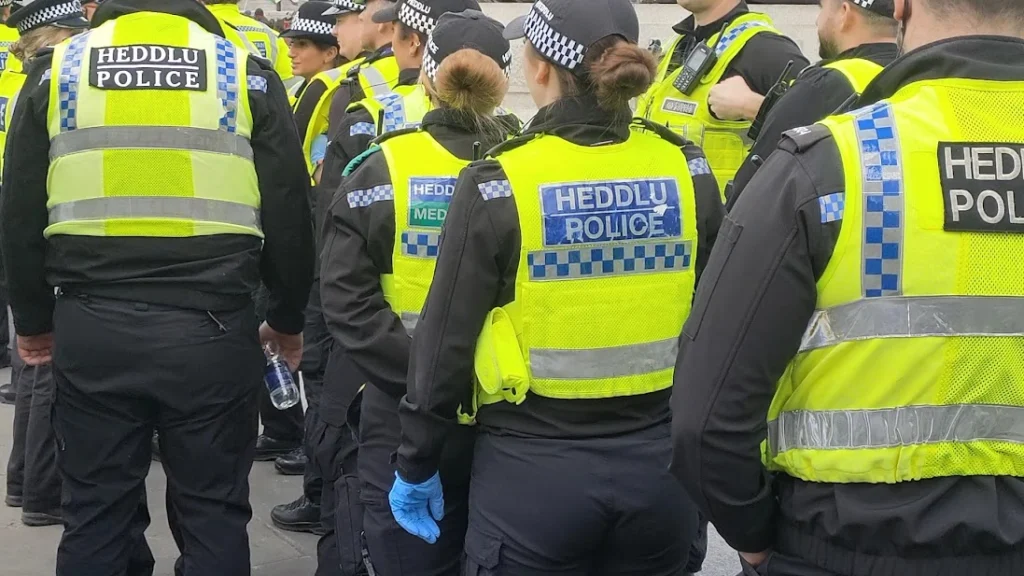
In Parliament Square, a women’s protest linked to issues around women’s spaces and women’s safety was assembling. A short distance away a counter-protest was also gathering consisting a those from the trans community and their supporters. This resulted in a visible police presence in and around Parliament Square.
Whilst the women’s march was still assembling, hundreds of trans activists suddenly appeared from the direction of Victoria Street and began marching around Parliament Square in order to get to Whitehall. Surprisingly they paid little attention to their rivals and indeed their rivals paid little attention to them.
The trans group, several hundred strong, marched up Whitehall and stopped just short of the Downing Street gates, thus blocking traffic heading in the direction of Trafalgar Square. As the buses backed up to Parliament Square, there was no move by officers present to move the crowd on and after about thirty minutes the buses began to turn around. The wisdom of the police decision was later to become apparent.
The women’s protest eventually left Parliament Square and turned on to the Embankment where they continued their walk. Eventually they took a left turn into Whitehall and walked down on the footway towards Downing Street to the predictable jeers from the trans group.
The women’s protest set up their sound system in front of the Ministry of Defence and held their own meeting, The decision to leave the Trans activists where they were ensured a comfortable sterile area between the two which was assisted by traffic moving along Whitehall towards Parliament Square.
The Defend our Juries ‘arrest me’ protest
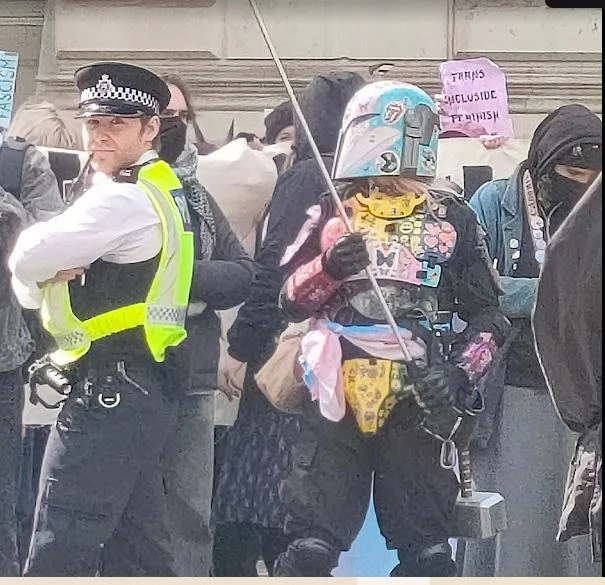
As all seemed stable, I decided to walk to Trafalgar Square where ‘Defend our Juries’ were holding another ‘arrest me’ event in relation to the proscribing of Palestine Action. Pending a final court verdict as to whether the decision by the Home Secretary was legitimate, the Met had a change of policy and announced that those showing support for Palestine Action would again be liable to arrest.
Trafalgar Square had previously been the venue for an ‘arrest me’ event which had run like a well- oiled machine as far as the Met was concerned. This was to be replicated and police serials from across the UK were again visible. A section of Trafalgar Square was barriered off for the use of police in assembling the serials and for the initial reception of those arrested. Those individuals would be initially searched and then taken to a prisoner carrier for transportation to where they would be processed.
Most ‘arrestees’ required four, five or even six officers to carry them through jeering crowds to the sterile area. The elderly and infirm were treated with great care and consideration by officers, who would clearly have preferred to have been performing duty elsewhere.
On two occasions individuals from the right appeared and drew a hostile crowd but they were quickly sent on their way by officers. The numbers of those supporting those being arrested whilst avoiding arrest themselves seemed down on the previous Trafalgar Square ‘arrest me’ event but the numbers arrested were similar at just over 500.
Dispersal, Guinea Bissau and Iran
My return to the Downing Street area of Whitehall saw the women’s protest packing up their sound system and banners before dispersing. The trans counter protesters did likewise after the women’s groups had left the area; there had been no disorder.
A third group of protesters had appeared opposite Downing Street during this period. This protest concerned Guinea Bissau; a country on the West Coast of Africa which is enduring a torrid period in its history. The hundred or so protesters were vocal, polite, cooperative with police with several posing for photos with officers.
Elsewhere in London, there were Iran linked protests with one involving a march to the US Embassy amidst suggestions that some Iranian dissidents were having doubts as to the tactics being employed by the US military at the behest of its Commander in Chief. There were no reports of untoward incidents however.
Abstractions, expense and morale
Throughout the week there were several ‘spontaneous’ smaller protests by pro-Palestinians whose concerns now include the situation in and around Iran. These are adding to the strains being placed on the Met in terms of abstractions, expense and morale.
Morale was a subject much discussed with Met officers who I’ve come to know and respect over recent months and years. Other police supportive observers and journalists have had similar discussions. The causes of what has become a crisis, are many and varied and quite simply, need addressing as a matter of urgency.
Chris Hobbs is a former Special Branch officer who follows public order operations as an observer for Police Oracle.
Category: Public Order
This level of almost daily protests on the streets of London must surely be taking a toll on the officers who I would guess are having countless rest days cancelled. The money will be nice but there comes a time when you just need to be able to actually have the time off with the family in order to have some semblance of a normal life.
The Metropolitan Police for nearly all of my service could be relied upon to deal with anything and everything 24/7.
Advertisement
Job of the week
Lead Investigator and Crime Manager – British Indian Ocean Territory
- British Indian Ocean Territory Police Service
- Diego Garcia, British Indian Ocean Territory (BIOT)
- £55k to £65k
Looking for a policing role that's different from anything else in the UK? The British Indian Ocean Territory Police is seeking an experienced Police Sergeant (Crime Manager & Lead Investigator) to join its team on Diego Garcia.
Read moreCoffee break