Article
Eyewitness: London sees a powerful yet incident free day of protest
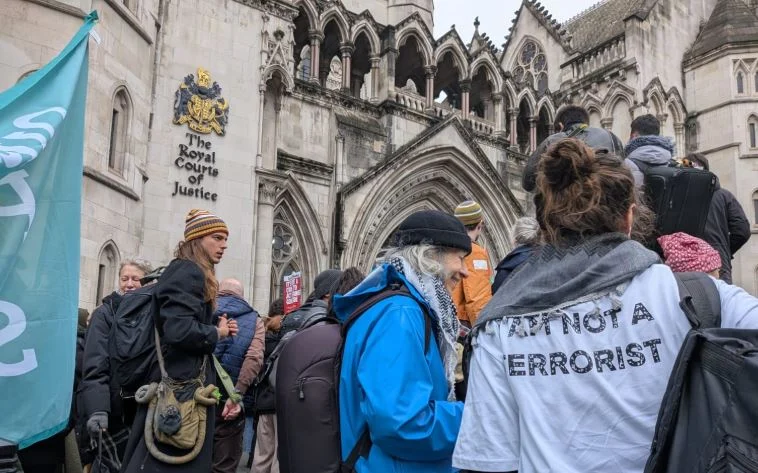

Chris Hobbs follows Saturday's Global Day of Protest with a rally in Downing Street followed by a march to the Iranian Embassy.
Relations between the Met and some protesters had occasionally become strained during previous protests. Police and protesters were injured when officers moved to arrest a male who had ripped down the Iranian Embassy flag. At another Embassy protest, several arrests were made when Kurdish and Iranian protesters clashed. In addition, during the most recent protest I witnessed scuffles between protesters and police after officers made an arrest.
On this occasion, numbers were well in excess of previous protests with most of Whitehall being turned over to protesters. An early guest speaker criticised the Met for allowing ‘Islamist’ protests on the streets of London; this was presumably a reference to the numerous Palestine protests and the speaker was clearly unaware of the legal requirements necessary to impose such a ban.
The speeches that followed were in both English and Farsi and interspersed with chanting and songs. Two noticeable chants taken up by th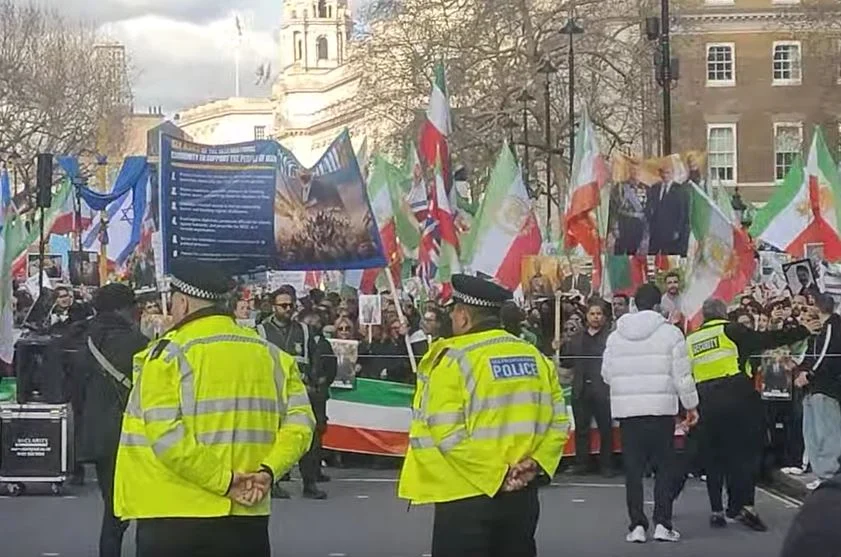 e crowd were ‘President Trump keep your promise’ and ‘Trump act now.’ This was in reference to the Presidents social media post that the USA, would, in the event of protesters being shot by the regime’s security forces, come to the rescue. It was also noted by observers that very few US flags were on display.
From Downing Street to the Iranian Embassy
As the speeches, songs, which included ‘God save the King,’ and chanting concluded the march set off towards the Iranian Embassy via Trafalgar Square, Pall Mall, Green Park and Knightsbridge. The march avoided Piccadilly where the first Palestinian flags of the day were sighted at an event designed to benefit the children of Gaza.
At a busy Green Park station, a number of protesters opted to end their protest but most continued to march, sing and chant. I decided to join the few protesters on the Green Park platform in order to reach the Embassy before the protesters. When I arrived, it was clear that there was a large police presence including a number of Territorial Support Group units. There was also a large crowd of protesters already present, watched over by police behind steel barriers. Significantly, however, officers were not ‘kitted.’
The arrival of thousands of marchers was a spectacular sight as viewed from the park opposite, which is raised from the road. Most continued walking past the Embassy while others congregated in groups and continued chanting. There were concerns that the road in front of the Embassy could become overcrowded but common sense prevailed.
Conditions imposed on the march by the Met stated that the event should end at 6.30PM. Shortly after that time, officers began to move quietly amongst the participants informing them that the time had come to leave the area. Amazingly, just twenty minutes later, the road in front of the Embassy was virtually clear.
In the park opposite the Embassy, the situation was a little chaotic. Traffic struggled to leave.
Estimates as to numbers involved in the protest varied from 100,000 to 15,000 and whilst the latter is probably more accurate, the event was impressive in terms of organisation and commitment. Perhaps the most moving aspect of all were those who were carrying photos of relatives and friends who were killed by the regime’s security forces during the uprising.
In any event, as far as the Met were concerned, this must have been the ‘near perfect’ demonstration in terms of cooperation and lack of incidents. Relations between police and those participating were excellent while the stewards were proactive and generally effective.
The day before
Friday the 13th saw good intentions to attend the Royal Courts of London for the ruling in relation to Palestine Action, thwarted by another mishap on the Elizabeth Line. A neighbour who is also a journalist and utilised a Lime bike, duly kept me informed of the verdict and the celebrations that followed. In the wake of the decision, footage emerged of officers referring to their own body worn cameras when informing illicit placard carrying protesters that they were still behaving illegally and could be the subjects of action later depending on the result of the Home Office appeal.
The day after
On a wet and windy Sunday, the Kurds assembled for their third march over recent weeks. A week ago, they assembled a disappointing turnout of around 500 and it was a similar story on this occasion with reports stating that again some 500 Kurds materialised and, on reaching Trafalgar Square, dispersed without incident.
This Saturday, as the fourth anniversary of the war in Ukraine approaches, there is a protest beginning at Piccadilly Circus. The public order spotlight however may well focus on Manchester Piccadilly where leftist, anti-racist groups will be gathering for a counter-protest against an event organised by Britain First.
Chris Hobbs is a former Special Branch officer who follows protests as an observer for Police Oracle.
Category: Public Order
Advertisement
Job of the week
DEPUTY COMMISSIONER OF POLICE
- Royal Cayman Islands Police Service
- Cayman Islands
- CI $121,356.00 – $155,316.00 per annum
The Deputy Commissioner of Police provides strategic leadership in support of the Commissioner of Police to ensure the effective management, direction, and oversight of the Royal Cayman Islands Police Service (RCIPS). The role is critical to advancing national security, enhancing public safety, and sustaining public trust across the Cayman Islands. The post holder is responsible for leading the development and execution of policing strategies, overseeing operational and organisational performance, and ensuring compliance with legal, ethical, and professional standards. The Deputy Commissioner also serves as the principal liaison with government entities, community stakeholders, and international partners, and assumes full command responsibilities in the absence of the Commissioner.
Read moreCoffee break