Analysis
Eyewitness: assessments and challenges as officers hope for a seasonal respite

Chris Hobbs reflects on another resource draining and morale sapping public order duty for officers.
(Main photo: Crime Scene Images)
We will probably never know whether the police officer or staff member designated to compile a risk/threat assessment for Saturday the 13th of December in respect of protests, will have regarded his or her task as something of a poison chalice. Two more tricky assessments were to follow as tensions increased due to the alleged deteriorating condition of Palestine Action hunger strikers.
On what would be a busy pre-Christmas Saturday in Central London in any event, officers would have to deal with three public order events; a Tommy Robinson led Unite the Kingdom (UTK) ‘Bring Christ back into Christmas’ gathering; the inevitable anti-racist counter protest plus a protest against the proposed government concept of digital ID’s.
As the threat assessment author will have been only too well aware, the last Tommy Robinson event saw a turnout of over 100,000 while the anti-racist counter-protest drew around 5,000 including several hundred masked, black garbed, ANTIFA activists.
This resulted in disorder which was contained thanks to some adroit policing. More than 20 arrests were made on the day and the Met expected to make another 50 as a result of ‘post-incident’ investigations.
Questions and decisions
The question that the luckless author would have to ask is how many of the 100,000 and 5,000 would materialise on a major Christmas shopping day which would also see a full football programme. The other issue would relate as to how many of the above 100,000 would be attracted to an event that gave the appearance of a religious evangelical gathering.
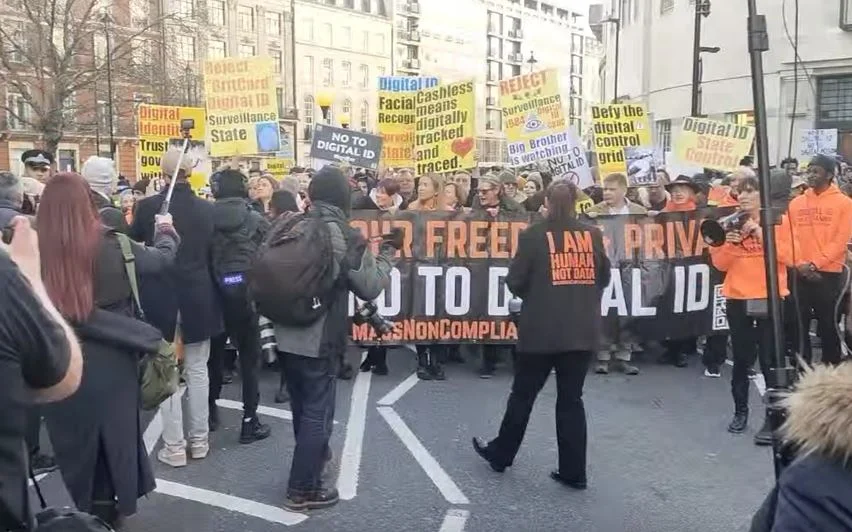
To complicate matters the third protest, against the carrying of digital identification as proposed by the government, would consist of a march from outside the BBC building in Portland Place to Whitehall. This ‘movement’ has garnered support from the left, notably the Worker’s Party of Britain together with many veterans of the anti-Lockdown protests. The carrying of digital ID would also be an anathema to many Tommy Robinson supporters together with those of the anti-racist left.
There was controversy on social media as the day approached due to the fact that the Met had referred to the Christian Christmas event as a ‘protest.’ Met Comms quickly responded, referring to comments made by the organisers as arrangements were being discussed, as follows;
“They’ve described it to us as a protest against the removal of Christianity from Christmas. Elsewhere we know they have also described the event as a ‘rally’.”
A decision was made that the North end of Whitehall would accommodate two stages; the first would be utilised by the Digital ID protest and the second, closer to Downing Street, would be occupied by the Christian Christmas event. There would then be a large sterile area with the anti-racist stage situated at the southern end of Whitehall within sight of Parliament Square.
Anti-racists, Billy Bragg and festive tunes
I opted to visit the Digital ID protest assembly point by the BBC and found it several hundred strong and in good voice. As the march launched itself, I utilised public transport and ended up at Westminster where I made my way around the corner to where the anti-racist protest was taking place.
The first observation of note was that officers were ‘kitted’ as opposed to their ‘day uniforms’ in anticipation of possible disorder. The next observation was that a number of those officers were from ‘aid’ serials outside London including Leicestershire, Hertfordshire and Essex. However, the anti-racists, who had begun their rally early as per the conditions imposed by the Met, numbered just several hundred and no masked ANTIFA activists were visible.
As promised, Billy Bragg was performing on stage and surprised everyone when he sang ’Jerusalem;’ a hymn which would perhaps have been more appropriate if performed from the opposite end of Whitehall. Nevertheless, a number of the more mature anti-racists joined in.
After the speeches concluded, the ‘DJ’ began playing some Christmas songs over the sound system. To the surprise of myself and watching officers this included the allegedly misogynistic and homophobic ‘Fairytale of New York;’ perhaps a song that you would not expect to hear at a leftist gathering. Nevertheless, it seemed to be appreciated by a number of activists, several police officers and myself who all happily sang along.
As I departed, the police were arresting a Tommy Robinson supporter who was clearly in the wrong place, was equally clearly the worse for drink and appeared happy to be placed in the back of a police van whilst shouting ‘Allahu Akbar.’
A walk via the Embankment to the opposite end of Whitehall saw some passionate oration and grim predictions from the digital ID stage. A short stroll down Whitehall saw a different, evangelical atmosphere with sermons from the stage and carols including ‘Come all ye faithful.’ The crowd, according to several estimates including that from the Met, was somewhere between 1,000 and 1,500.
Everyone needs good neighbours
It would also seem that, based on comments from the respective stages, the Christian Christmas revival event and the digital ID protest were uneasy bedfellows in that northern section of Whitehall. The female Chairperson of the digital event was also extremely critical of the Met accusing its officers of brutality during the covid period.
During the course of events, I opted to walk up the Strand to pay my respects at the Jim Morrison memorial on the anniversary of his death. Jim was a Detective Constable who was fatally stabbed whilst confronting a criminal whilst off duty. His killer has never faced justice.
On my return to Whitehall, the Tommy Robinson event had ended and those attending were walking past the digital ID stage where a speaker was warning his audience of the unseen menace of globalisation.
The end result; a Q-word day
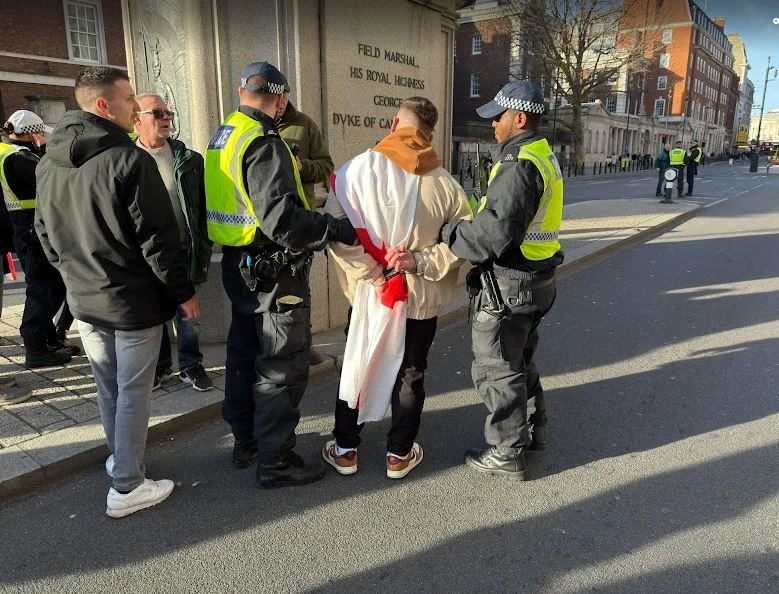
Parked in the side streets were numerous police carriers; some were those of the Met’s Central London Reserve while others were those from county forces. The three protests had resulted in just two arrests, the second being an assault on a mounted officer by a male draped in a St. George’s flag.
However, given previous events, there was no way that the above-mentioned author of the threat assessment or Met planners, could take any chances on one of the busiest days of the year for central London, as illustrated by a nightmare journey home due to packed underground trains.
The Met had sufficient resources in place to deal with any eventuality and that of course is the way it should be. There were no headlines relating to central London over the weekend but Met officers and indeed all police across the UK were about to be bonded in empathy and sympathy with their Australian colleagues.
Palestine linked protests continue
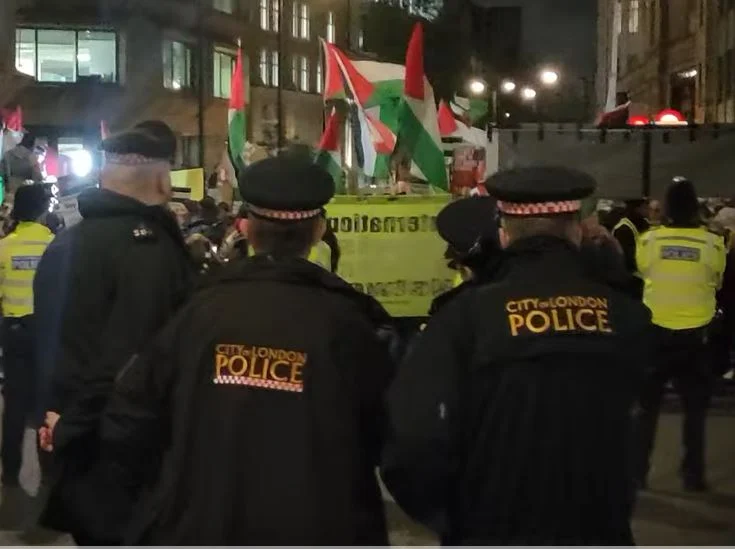
The Bondi beach atrocity inevitably created shockwaves across the world and resulted in articulated concerns as to the safety of Jewish Community. A planned pro-Palestinian march and rally on the Tuesday was to begin in Portland Place, close to both the BBC and a synagogue and due to end in Whitehall: However, that a major Hannukah event was due to take place in Trafalgar Square saw conditions imposed in respect of both areas. There was still, however a noisy pro-Palestine ‘walkabout’ by activists.
The result saw an uninterrupted Hannukah celebrations at the above venues but further issues occurred on Wednesday. In Surrey, following reports that a hunger striker on remand in Bronzefield Prison was dangerously ill, protesters scuffled with police and three arrests were made outside the prison gates.
Wednesday evening saw a further pro-Palestine/support the hunger strikers protest outside the Ministry of Justice. An earlier joint statement from the Commissioner of the Met and Chief Constable of Greater Manchester indicated that there would, in the aftermath of Bondi Beach, be a stricter enforcement of public order legislation involving chants.
The term ‘intifada’ thus became actionable and two arrests were made early during the protest which attracted around 400 activists. Towards the end of the evening a minor scuffle involving two pro-Israeli Inserts was quickly dealt with and shortly after this incident, the rally ended with more chanting.
The Met, assisted by the City Police public order cadre, were clearly determined there would be no ‘walkabouts’ after the event. Carriers and officers cordoned off two possible exits and there were scuffles as another arrest was made with protest leaders very much in the faces of officers. In total five arrests were made during the course of the evening.
After the end of the protest, the resource intensive nature of these events became apparent. Numerous carriers could be seen parked in adjacent streets filled with bored officers abstracted from local policing. Yet there was little choice in respect of such a deployment due to the unpredictable nature of these protests. Had the majority of the protesters produced pro-Palestine Action placards then all would have become arrestable and the Met would again have been criticised if the resources were not available.
At present, the next pro-Palestine event in London is not scheduled until the 31st of January but this could change depending on the condition of the remaining hunger strikers: Two have recently ended their protest and doubtless police commanders will hope that others will follow suit.
Chris Hobbs is a former Special Brnach officers who follows protests for Police Oracle as an observer.
Category: Public OrderWellbeing
Advertisement
Job of the week
DEPUTY COMMISSIONER OF POLICE
- Royal Cayman Islands Police Service
- Cayman Islands
- CI $121,356.00 – $155,316.00 per annum
The Deputy Commissioner of Police provides strategic leadership in support of the Commissioner of Police to ensure the effective management, direction, and oversight of the Royal Cayman Islands Police Service (RCIPS). The role is critical to advancing national security, enhancing public safety, and sustaining public trust across the Cayman Islands. The post holder is responsible for leading the development and execution of policing strategies, overseeing operational and organisational performance, and ensuring compliance with legal, ethical, and professional standards. The Deputy Commissioner also serves as the principal liaison with government entities, community stakeholders, and international partners, and assumes full command responsibilities in the absence of the Commissioner.
Read moreCoffee break