Article
Eyewitness: another weekend, another set of protests
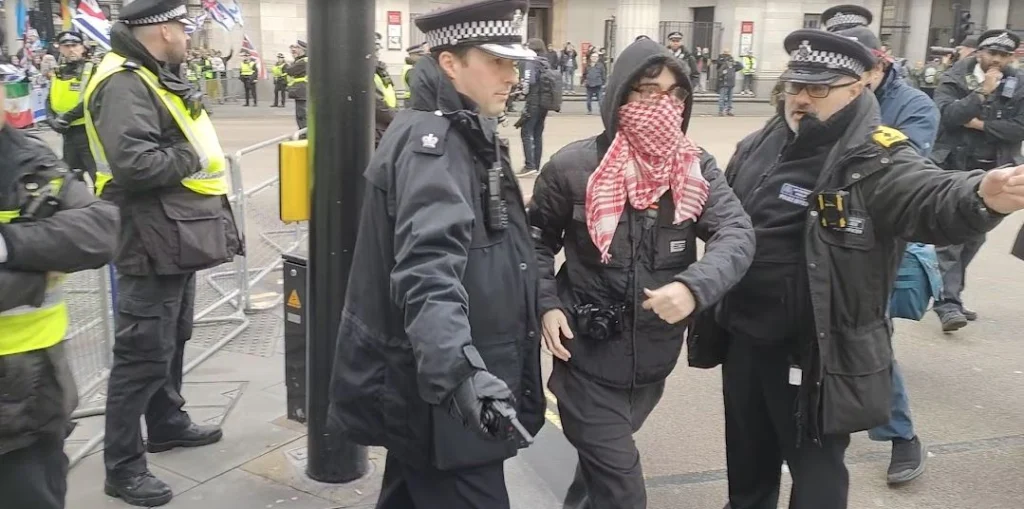

Chris Hobbs witnesses the professionalism of Met public order officers charged with policing various rival protests in the capital over two long days of weekend duty.
That the Met were anticipating a challenging day of protest on the 31st of January was illustrated by a press conference held just days earlier where some startling statistics as to the draining cost of protest were revealed in addition to policing arrangements for the day in question.
DAC Harman confirmed that UKIP’s intended Christian event would, by virtue of public order conditions imposed, not be held in Whitechapel or in any other part of Tower Hamlets because of the high level of disorder that would inevitably result.
This imposition, which mirrored conditions imposed upon a proposed UKIP Whitechapel rally back in October, meant that they relocated their religious march and rally to central London. The fact that UKIP complied with those conditions back in October ensured that on this occasion hundreds of masked local youths did not take to the streets while anti-racist groups stated that they would also relocate their protest to central London.
The current complexities of public order policing
The protest scenario was complicated by the decision of the Palestine Solidarity Campaign (PSC) to hold their first major protest of 2026 which would doubtless attract many thousands. This elicited a response from the pro-Israeli group, Stop the Hate who appear to re-established communication with the Met; they stated that they would hold a static counter protest.
In addition to this familiar scenario, the complex situation in Iran and elsewhere in the Middle East has spawned a whole series of protests in London, some of which have been violent and requiring a virtual permanent police presence at the Iranian Embassy in addition to the usual 24-hours diplomatic police protection.
These tensions were illustrated the previous Sunday when hundreds of Kurdish youths attempted to attack an Iranian monarchist rally in Whitehall but were frustrated by some exemplary policing.
UKIP, PSC and Stop the Hate have their say
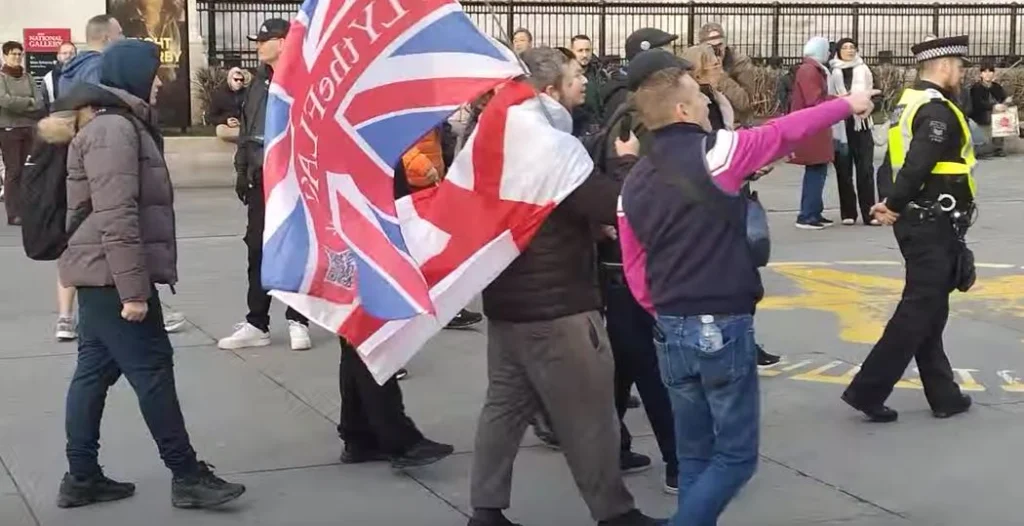
As the 31st of January approached, the Met announced that the UKIP march would end at the North end of Trafalgar Square on the raised area in front of the National Gallery. This prompted a furious response from the PSC due the fact that their march would pass by the southern end of Trafalgar Square before concluding with a rally in Whitehall. Neutral observers felt that this arrangement would permit leftist activists to attend any anti-racist counter-protest in respect of UKIP in addition to the PSC rally.
The day itself began with PSC protesters gathering near Russell Square with the issues of the hunger strikers and the Palestine Action proscription very much to forefront of the PSC agenda together with the fact that the term ‘Intifada’ was now on the banned list; the plight of those in Gaza however was not forgotten during the course of the day.
Before the march set off, chants of ‘Intifada Revolution’ could clearly be heard from amongst the massed ranks of protesters however, because they were so densely packed it would not have been possible to identify the culprits.
Around 200 Stop the Hate activists and supporters were again located behind barriers in the Aldwych; these numbers appeared down on previous occasions but they were in possession of an extremely loud system and as the PSC march appeared, this was put to good use. An innovation was a raised screen which was split into two; one half showed scenes from the streets of Iranian cities as the security forces murdered thousands; the other murderous scenes from the October the 7th massacre of Israelis by Hamas.
I wasn’t however, the only observer who felt that singing ‘you can stick your Palestine up your arse’ was less than compatible with the scenes being shown on repeat to passing pro-Palestinians and members of the public. The exchange of insults continued for the duration of the march and there was one arrest of an individual reportedly for some form of Intifada display.
The Jewish bloc and support for the Iranian regime
There was, again, a large Jewish bloc amongst the PSC marchers who were clearly visible thanks to banners and placards. There was some amusement all round when, directed against that passing Jewish Bloc came a loudspeaker comment; ‘You’re as Jewish as a bacon sandwich.’
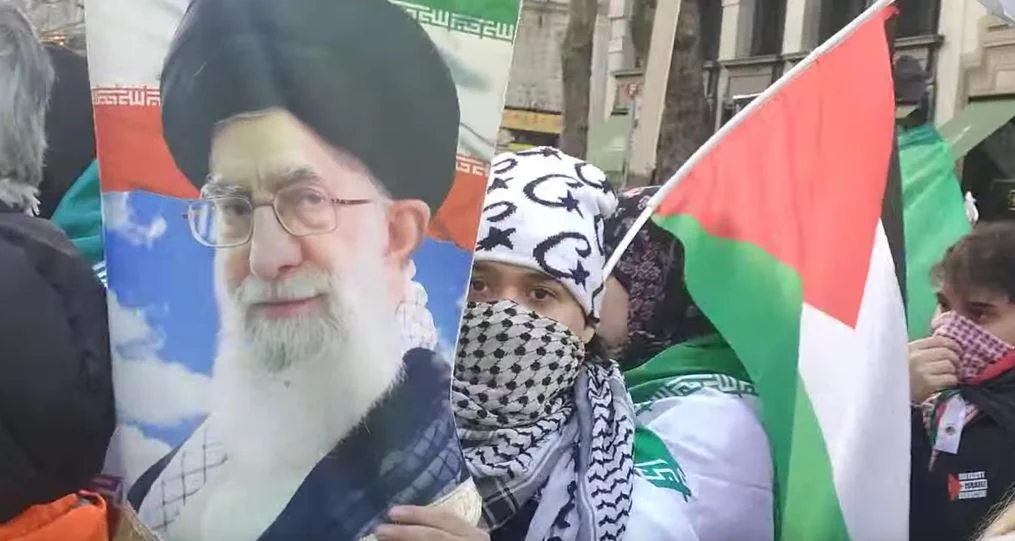
More controversial was the presence towards the end of the march of a contingent linked to the current Iranian regime. Placards of Iran’s Ayatollah Ali Khameniei were clearly visible and just after passing the ‘Stop the Hate’ there was some form of altercation involving the group which saw police officers responding. This drew a sarcastic comment from Stop the Hate via their sound system that it was good to see Met police officers doing their duty ‘at last.’
Ethnic officers targeted
After the march had passed, I and other observers made our way along the Strand towards Whitehall. However, after a short distance, a police cordon and a small crowd heralded an arrest with the prisoner being detained behind the cordon. Amongst the police cordon was a young turbaned Sikh officer. He was being harangued by a male who clearly felt that being a Sikh or perhaps being a person of colour, was incompatible with being a police officer.
The officer concerned behaved impeccably and didn’t flinch but it would appear that he has been previously subjected to this form of abuse. Other ethnic minority officers have also been subjected to abuse during these marches on the apparent presumption that they are ‘traitors.’
On arrival at Trafalgar Square, it became clear that the UKIP religious procession consisting of around 200 activists and supporters had arrived. Apparently, on arrival, they had been greeted by about ten ‘ANTIFA types’ who hurled some abuse before being moved on by police.
Fears that they would be confronted by those on the PSC march proved groundless. One individual on a bike complete with a Palestine flag, received some abuse as did three men sporting Palestine colours who were on the receiving end of ‘You can stick your Palestine up your arse.’ Police quickly moved in and that was the extent of the disorder in Trafalgar Square.
Interestingly, also present in front of the National Gallery were two Iranian groups who were separated by Fulun Gong, a spiritual movement persecuted by Chinese authorities. One Iranian group represented those who ultimately wish Iran to become a republic; the other consisted of the Iranian Monarchist opposition who wish to restore the Shah.
It was this latter group who had laid out a moving display consisting of black body bags, flowers with names and photographs of victims who perished at the hands of the Iranian security forces during the recent bloody disorder.
I walked back down to the PSC march just in time to see the group who support the current Iranian regime complete with a mullah about to enter Whitehall; thus, within yards of each other there were the three main competing factions who are currently prevalent in Iranian politics.
Generally peaceful with a small number of arrests
The PSC rally in Whitehall saw a number of speakers but as the event drew to its conclusion, it was clear that many had already left for home. Nevertheless, organisers would have been pleased with the numbers attending although the final figure of 100,000 given by those organisers was clearly a gross exaggeration.
In all the Met reported 13 arrests including the activist Peter Tatchell. A number of the arrests were for placards that included the phrase, ‘Global Intifada’ but also containing other phrases that would, presumably, constitute a defence in the event of a court appearance. Palestine Action placards also featured in the arrests.
The Met hierarchy must, however, have been delighted that a day filled with the potential for disorder passed off without incident.
Sunday sees no respite for the Met
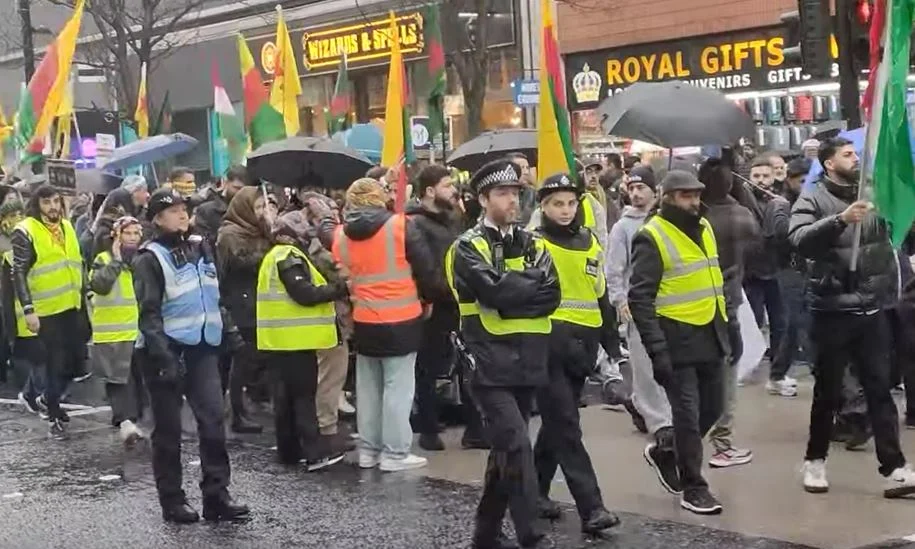
There was however no respite. On a Sunday when PC Rain appeared periodically throughout the day, there was another Kurdish march. The fact that the previous Sunday, hundreds of Kurdish youths attempted to attack an Iranian monarchist rally in Whitehall, resulted in another substantial policing operation with officers reporting for duty that morning on their boroughs, being told that they were being relocated to central London.
The Kurds met at Marble Arch but it was apparent that the youthful element were not there in the numbers seen the previous week. The march was uneventful and ended in Trafalgar Square however police were only too well aware that the rival Iranian monarchist group were again holding a rally by nearby Downing Street.
The speaker system used by the Kurds was woefully inadequate but it appeared they were unaware of the rally occurring a short walk away along Whitehall.
The Iranian rally saw more discontent with the Met. This is the group whose leaders accused the Met of being on a par with the IRGC (Iranian Revolutionary Guards). This was after the incident at the Iranian Embassy where an activist tore down the Iranian flag, was arrested by police who were swarmed and attacked by protesters. Batons were drawn and both police and protesters were injured.
On this occasion the complaint was in relation to barriers. The Met closed off one half of Whitehall and used barriers to ensure traffic continued to run from Parliament Square to Trafalgar Square. The police were berated for not closing Whitehall completely.
In fact, as the rally was ongoing, thousands more marchers arrived from the Iranian Embassy. Again, those on the stage complained about the barriers but by directing marchers to the rear of the barriered area officers managed to accommodate everyone and the traffic kept flowing. Meanwhile those who had attended the Kurdish march and rally were peacefully dispersing.
A return march to the Iranian Embassy
As the Iranian rally was drawing to its conclusion with the playing of national anthems of both the UK and Iran, hundreds of protesters broke away from the rally and began marching down Whitehall towards Parliament and Victoria Street. Stewards were doing their best to minimise the disruption but one half of Victoria Street was blocked.
They turned into Buckingham Gate and it was soon confirmed via a friendly organiser that they were heading back to the Iranian Embassy. Three police carriers appeared and followed the noisy crowd. Having been informed by my Fitbit, that I was approaching the ten-mile mark for the day and feeling every yard of it, I decided enough was enough. However, it appears that shortly after the marchers arrived at their destination, they were informed by police that they had to disperse and they duly complied.
It was only later that I discovered that Kurdish and pro-Monarchist Iranians had clashed outside the Iranian Embassy earlier that afternoon. Four of the Kurdish group had been arrested for offences of affray, violent disorder and assault on police.
It goes without saying that after another weekend of challenging, public order events there was no praise for the Met from the media, politicians or participating organisations.
It seems inevitable that frequent, resource draining, contentious public order events in London will continue for the foreseeable future with consequent adverse effects on Met police morale, resources and finances.
Chris Hobbs is a former Special Branch officer who follows public order events as an observer for Police Oracle.
What’s really disgusting is seeing officers of an ethnic minority background getting racial abuse…often by those who call themselves ‘anti racist.’ They assume that people of an ethnic minority must all think the same, have the same experiences or background, which is ironically racist and ignorant. In some ways it’s funny seeing the self prescribed ‘liberal, caring, be kind brigade,’ show themselves to be the most intolerant and obnoxious people.
Also, no praise for the Met. If they weren’t at these protests, keeping the sides apart, what do these habitual whiners think would happen? That they would all get along nicely….because that clearly isn’t the case. If these protests weren’t policed, a lot of people would end up seriously injured or dead, but that obviously doesn’t cross the numbskull minds of these people
Advertisement
Job of the week
DEPUTY COMMISSIONER OF POLICE
- Royal Cayman Islands Police Service
- Cayman Islands
- CI $121,356.00 – $155,316.00 per annum
The Deputy Commissioner of Police provides strategic leadership in support of the Commissioner of Police to ensure the effective management, direction, and oversight of the Royal Cayman Islands Police Service (RCIPS). The role is critical to advancing national security, enhancing public safety, and sustaining public trust across the Cayman Islands. The post holder is responsible for leading the development and execution of policing strategies, overseeing operational and organisational performance, and ensuring compliance with legal, ethical, and professional standards. The Deputy Commissioner also serves as the principal liaison with government entities, community stakeholders, and international partners, and assumes full command responsibilities in the absence of the Commissioner.
Read moreCoffee break