Article
Eyewitness: a New Year and resource draining protests recommence
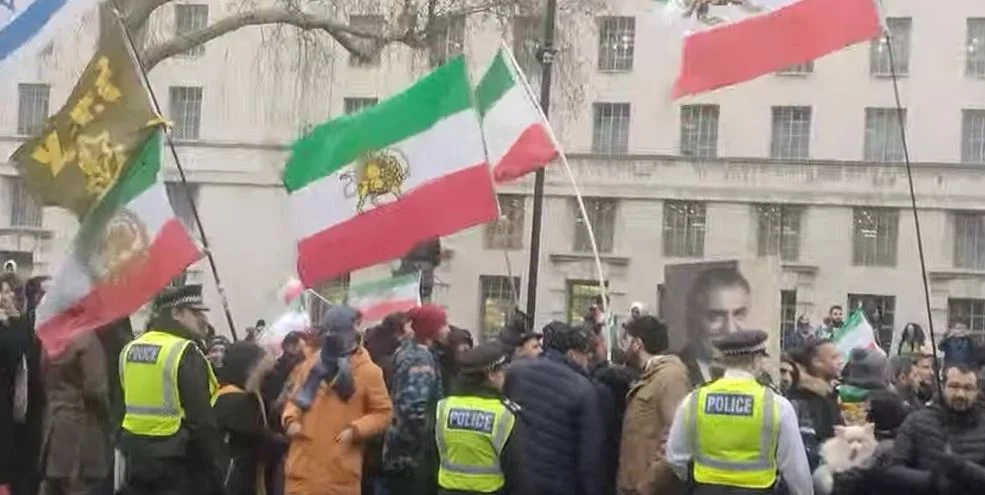

Chris Hobbs attends another series of central London protests connected to events happening outside the UK.
The festive period saw a partial respite for Met and their City and British Transport Police colleagues in respect of public order events. Football matches still had to be policed and there were sporadic smaller protests linked primarily to the pro-Palestinian cause and the issue of the hunger strikers.
The abduction of the Venezuelan President by US special forces prompted emergency protests in Downing Street and the US Embassy at the start of the New Year while a picket outside a Jewish restaurant in Notting Hill by a pro-Palestinian Jewish group which resulted in scuffles with Met officers, attracted much comment including criticism from both sides. As has frequently occurred since the 7th of October massacre in 2023, those on the pro-Israeli side accused police of not doing enough while those on the pro-Palestinian side accused officers of heavy-handed policing.
Iran and Venezuela crises prompt protests
The situation in Iran was then added to the mix with the result that Saturday January the 10th saw a return to the familiar routine of Met officers being abstracted from their boroughs and transported into central London to either sit in carriers waiting to be deployed or standing on cordons watching over protesters.
Whilst the Iranian Embassy saw a predictable protest by those opposed to the current regime, it would have attracted little attention but for the efforts of an agile protester who somehow reached the first floor of the Embassy building and removed the official Iranian flag before displaying another linked to those who support the restoration of the Iranian monarchy.
In Whitehall, the situation was rather more complex; A protest concerning the situation in Venezuela was attended by anti-racists, pro-Palestinians and Venezuelan nationals many of whom were carrying anti-Trump placards. They were grouped up directly opposite Downing Street. However, the situation was exacerbated by the presence, on the narrow central reservation, of around twenty pro-Trump English activists draped in St. George’s flags who were in possession of a very loud portable sound system.
After a debate with officers, this group were moved across to the opposite footway. A few minutes later they attempted to cross back in order to ‘mingle’ with the anti-Trump protesters. They were again ushered back to the opposite footway by police before deciding enough was enough and walking down towards Parliament Square.
The Venezuela protest was in full swing with most speeches predictably focussing on Donald Trump, when a sizeable group of around 200 appeared carrying flags which puzzled observers. A brief conversation established that these were in fact Kurdish
protesters who were concerned that they were again being attacked by Turkish and other hostile forces despite assisting the Americans in the fight against ISIS. In essence they felt betrayed.
A ‘potpourri’ of Whitehall protests
After some toing and froing across the road, they eventually formed up just along from the Venezuelans and leftists and conducted their own meeting. Neither seriously impacted on the other. However, attention was then drawn to yet another protest commencing just along from the Kurds. Whilst there was an ongoing protest at the Iranian Embassy, this was an anti-Iranian government women’s group and on view were photos of those allegedly murdered by the regime.
The leftist protest was the first to finish but that was simply the signal for Venezuelan nationals to commence their own meeting which was largely in Spanish but clearly consisted of those who were committed Maduro supporters.
Sunday and a major Iranian rally
This potpourri of Whitehall protests ended without incident but the following day on Whitehall, Met officers, abstracted from their normal duties, were back policing a protest fuelled by ongoing events in Iran. In order to accommodate the several thousand protesters, most of whom were Iranian, the Trafalgar Square to Parliament Square Whitehall section of road. was closed to traffic.
Traffic still flowed in the opposite direction, from Parliament Square to Trafalgar Square but officers, at times, struggled to keep that area of road close to Downing Street, free of protesters. The footway too presented problems as protesters and the curious used it as a vantage point obstructing pedestrians. On the same footway by the Downing Street gates, ‘citizen journalist’ Tommy Robinson, complete with microphone attracted a crowd akin to a rugby scrum, as he both gave and conducted interviews. He had called upon his supporters to support the protest on the grounds that some Iranian dissidents had supported the Israeli cause.
Another group to support the protest was the pro-Israeli organisation; Stop the Hate. They normally organise static counter-protests against the large Palestine Solidarity Campaign marches but have recently terminated their relationship with the Met on the grounds that the force shows bias towards the pro-Palestinians.
The actual rally, complete with impassioned speeches, passed off without incident. Concerns that rival Iranian anti-government groups could clash, proved unfounded and indeed most of those present appeared to support a return to Iran of the monarchy under Reza Pahlavi.
The rally finished with the UK’s national anthem followed by that for Iran and many slowly began to make their way home. Others, in the fashion of the pro-Palestinian protests, formed up into groups and, with the aid of drums, indulged in ‘chant fests.’
A march and another flag removal
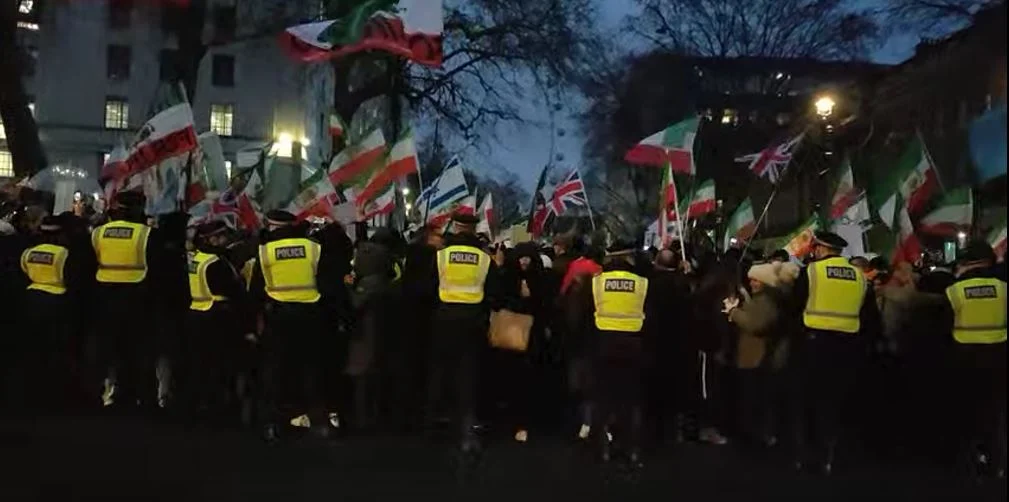
After a while however, many of the crowd remaining began to move in the direction of Trafalgar Square and it very quickly became a march that made its way along Piccadilly, past Green Park and towards Hyde Park Corner. It became clear that the march was headed to the Iranian Embassy and that the Met were aware that it was likely to take place. The marchers intended to join a smaller protest which had been ongoing during the day.
TSG officers provided the escort and relations with the marchers were amicable with instructions being obeyed. At Hyde Park Corner, cold tired and hungry, I opted to begin the journey home only to encounter chaos caused by disruption to the Elizabeth Line due to a trackside fire in Southall. However, that ‘retreat’ meant that I missed, for the second day, an incident where the Iranian Embassy flag was ripped down by a protester who managed to climb on to that first- floor balcony where the flagpole is located.
Needless to say, the fact that two similar incidents took place on successive days resulted in the British Ambassador in Tehran being summoned by the Iranian Foreign Ministry and rebuked.
Further challenges ahead
Further challenges however, lie ahead for the Met which include a UKIP organised Christian religious procession in Whitechapel on January 31st. A UKIP event scheduled for Whitechapel in October last year had conditions imposed on it by the Met that compelled activists and supporters, to relocate to central London. Hundreds of masked local youths however took to the streets while anti-racist groups were also present in numbers.
Conditions can still be imposed on religious marches by police but obviously the propaganda value and outrage generated by such action will be considerable.
This ‘religious’ procession would appear to coincide with the first major Palestine Solidarity Campaign march and rally of 2026. Football matches, including the high-risk Tottenham versus West Ham encounter, are due to take place on the same day. It seems likely therefore that the cash-strapped Met will require expensive ‘mutual aid’ from other UK forces.
Chris Hobbs is a former Special Branch officer who follows public order events as an observer for Police Oracle.
Category: Public Order
Utterly ridiculous. We (the UK government) are so weak. Allowing unfettered protest week in week out regardless of the huge cost and disruption. My six year old could have written more effective and tactically sophisticated legislation than this ongoing license for chaos!
Advertisement
Job of the week
DEPUTY COMMISSIONER OF POLICE
- Royal Cayman Islands Police Service
- Cayman Islands
- CI $121,356.00 – $155,316.00 per annum
The Deputy Commissioner of Police provides strategic leadership in support of the Commissioner of Police to ensure the effective management, direction, and oversight of the Royal Cayman Islands Police Service (RCIPS). The role is critical to advancing national security, enhancing public safety, and sustaining public trust across the Cayman Islands. The post holder is responsible for leading the development and execution of policing strategies, overseeing operational and organisational performance, and ensuring compliance with legal, ethical, and professional standards. The Deputy Commissioner also serves as the principal liaison with government entities, community stakeholders, and international partners, and assumes full command responsibilities in the absence of the Commissioner.
Read moreCoffee break