Article
Viewpoint: when policing fails every officer feels the impact

Former Met officer Chris Hobbs says the Panorama documentary shows that policing is unlike any other profession when it comes to apportioning blame.
It was a programme that had received considerable advance publicity over weeks and, as the day dawned, officers across the Met and indeed the country viewed the upcoming revelations with apprehension. Whatever the content, the result was inevitable; that all Met officers would be collectively smeared with morale, already on the floor, suffering another blow.
The undercover reporter spent seven months accumulating evidence against eleven officers and was ideally placed in the Met’s custody suite to gain the confidence of those rogue officers whose behaviour and attitudes were, quite simply, appalling; albeit, in two cases, encouraged by copious quantities of alcohol.
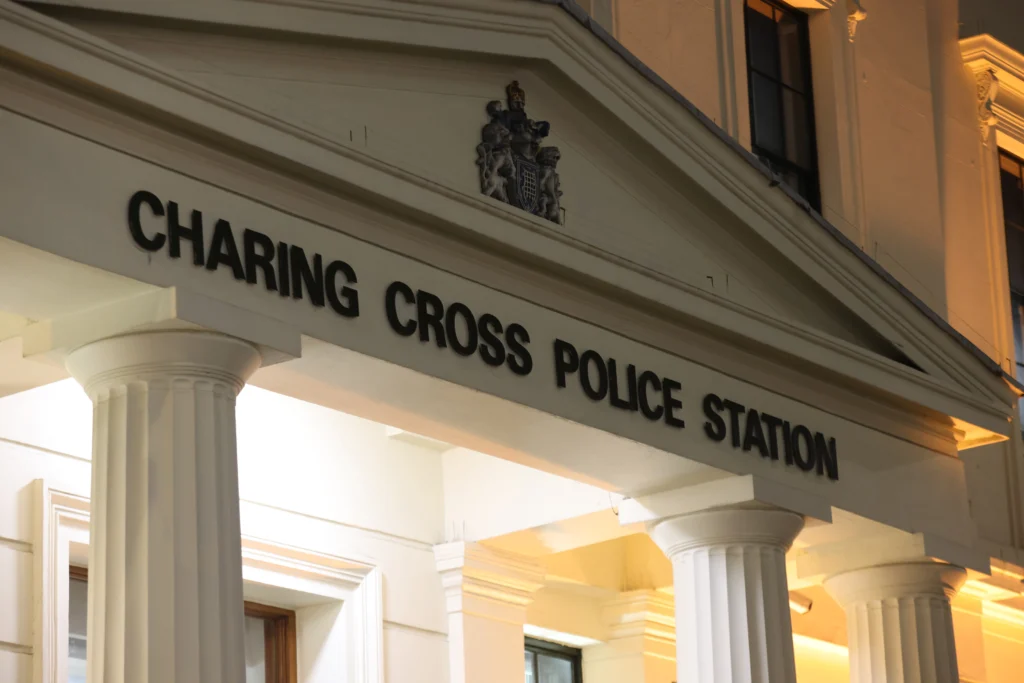
This wasn’t the first time that Charing Cross police station had been in the headlines; Operation Hotton focused on the station’s ‘Impact Unit’ whose remit was to deal with specific criminality that blighted the West End of London. The unit, rather like naughty boys in a school forming a gang, attracted some whose behaviour was also reprehensible; the end result was that two officers were dismissed for gross misconduct and two resigned. Others were sanctioned but kept their jobs.
The appointment of an undercover reporter as a designated detention officer (DDO) will pose some embarrassing questions for the Met in terms of recruitment and vetting. Similar questions are also being asked in respect of the appointment of officers who have subsequently fallen foul of the Met’s disciplinary procedures and have been dismissed or resigned. The general view is that nationally, cutbacks impacted on recruitment and vetting and that this was exacerbated in the Met by the virtual closure of their world-renowned training centre at Hendon.
The policing area covered by Charing Cross is an extremely challenging one as it includes much of the West End of London which attracts tourists from at home and abroad; this in turn invites criminality. The nightlife and world- famous department stores add to the challenging mix faced by officers as does the presence of a large homeless population who present their own challenges in terms of alcohol and substance abuse together with mental health issues.
At least 600 officers are stationed at Charing Cross. However, was there an attempt by the programme makers to provide some sort of balance as a counter to the vile behaviour that was displayed?
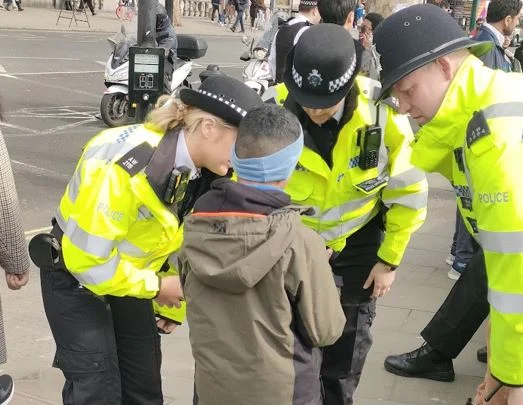
There was the briefest of clips showing police compassionately attempting to calm down a male who was clearly suffering a mental health crisis. This was accompanied by the reporter stating that he saw, presumably during his seven months, ‘many police officers doing their jobs professionally and with empathy.’
He later went on to say that he saw; ‘many police officers doing their job to the best of their ability; hats off to them.’ He further stated that officers often dealt with individuals who had ‘complex mental health needs in addition to violent confrontational people.’
It’s perhaps worth noting at this point that during any 24-hour period, an examination of the CAD system which covers Westminster will invariably show acts of bravery, kindness and compassion by Charing Cross police officers.
Not just the police
Of course, it’s not just the police, whose behaviour and attitudes should be beyond reproach. Dame Laura Cox, was damning when she published her report into the behaviour of male MP’s; 56, according to her report, had been the subject of allegations relating to sexual misconduct.
The NHS too has suffered from allegations of bullying, sexual misconduct and racism which can be found across the service. In 2023, the BMA stated that the ‘corrosive culture of bullying remains in part of the NHS.’
In 2024, Sky News reported that almost a third of female surgeons who responded to a survey the previous year, said they had been sexually assaulted by a colleague while two thirds claimed to have been the target of sexual harassment.
Racism too, within the NHS as opposed to being subject to racist abuse and assault by patients and relatives, remains a problem according to a 2024 survey and report by Middlesex University.
Then we also have the failures at several maternity hospitals which resulted in the needless deaths of mothers and babies.
Yet, these failures do not, rightly, result in the denigration or, and I unapologetically use the phrase again, collective smearing of all NHS staff. However, when policing fails, every officer feels the impact. At present, UK policing is being subjected to an onslaught from social media posts emanating primarily from the far-right. These are often presented in the form of ‘fake’ or distorted news.
Crass behaviour and communication
None of the above, of course, somehow excuses the crass behaviour of the officers exposed during the programme. It does, however, illustrate a lack of balance in terms of the coverage of policing issues. This is, in part, due to ‘comms’ departments not keeping pace with issues created by the advance of social media.
Fake or misleading news can be set in tablets of stone within minutes and subsequent, belated police comms rebuttals have little effect. There are, however very noticeable green shoots of improvement especially from the Met who have been quick to place in the public domain, examples of good police work. They were also quick to correct misleading posts in relation to the recent Unite the Kingdom’ protest and counter protest.
Sir Mark’s comments would have done little to maintain the diminishing morale of his officers. Placing the occasional ‘one liner’ as to the majority of his ‘good’ officers garners no traction amongst the media or, indeed, those very officers. Many of those ‘good’ officers have left or are planning to leave the Met.
As reprehensible and indeed as vile as the actions of those eleven Charing Cross officers were, the fact is that, on a daily basis, the positive actions of those on the Met’s front line massively outweigh the negatives.
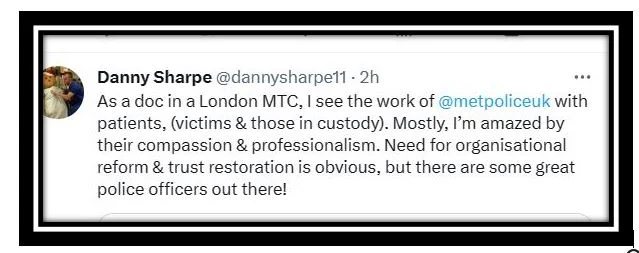
Finally, I’ll conclude with this post which was placed on Twitter in the immediate aftermath of the Baroness Casey review. Dr. Sharpe is one the UK’s leading trauma surgeons.
Category: Misconduct proceedingsVetting
Thus it ever was and will continue to be.
For some strange reason everybody else except for the police can have appalling examples of behaviour from a small section of their workforce but the entire organisation is never smeared with the same brush.
The NHS has and continues to have ongoing problems with high mortality rates within the maternity units. Is anyone suggesting root and branch purging of the staff. No.
The Met sadly being in the frame again for a cherry picked selection of bad behaviour over several months will again gift us another Macpherson style enquiry whereby the entire police forces are made to pay the price.
What about the poor vetting? What about they were drunk when they said it? What about MPs and doctors who are worse? What about fake news? What about the comms teams not being good enough? What about the Commissioners response? What about the many good apples?
Chris… your article reads like a classic case of ‘whataboutism’. A response which has plagued the Met for too long, preventing proper critique of fundamental issues and concerns.
The comments in the documentary were utterly shocking and the hidden sub-culture it exposed was deeply disturbing. If, having watched this, your main takeway is to question how the undercover was able to get through vetting, I’m afraid that policing and the Met still has a very long way to go.
Whilst there is no excuse for bad behaviour by police, or indeed anyone in the public service there does seem to be a lack of understanding and appreciation of the type of people that sometimes have to be dealt with forcibly, whether physically or verbally and that afterwards as a form of release officers talk about it in perhaps not too glowing terms that those who wear rose coloured glasses and are so out of touch with reality would deem inappropriate. Once upon a time before police canteens were closed there was a type of sanctuary where verbal release could take place amongst understanding ‘streetwise’ colleagues, but even were they still in place with the new breed of police officers and staff being recruited who have yet to experience the harsh realities of life at the sharp end of policing one must be so wary of any expression less you get reported to Professional Stendards because it didn’t fit the informants ‘holier than thou’ narrative.
I’m not completely happy with the way this program was made. A journalist/reporter joins the police then films his new colleagues waiting for the juicy racist, sexist, homophobic and inappropriate comments and behaviour which is compiled and made into another salacious police wrong uns program……
Who knew he was filming, who decided when and what to film, who had editorial control. How many hours of filming was made just to catch these snippets of bad behaviour.
The official custody cctv aside is there no privacy issue at stake here. There must surely be a suspicious eye cast at new members of staff and in all cases involving the police, does the means justify the ends.
Advertisement
Job of the week
DEPUTY COMMISSIONER OF POLICE
- Royal Cayman Islands Police Service
- Cayman Islands
- CI $121,356.00 – $155,316.00 per annum
The Deputy Commissioner of Police provides strategic leadership in support of the Commissioner of Police to ensure the effective management, direction, and oversight of the Royal Cayman Islands Police Service (RCIPS). The role is critical to advancing national security, enhancing public safety, and sustaining public trust across the Cayman Islands. The post holder is responsible for leading the development and execution of policing strategies, overseeing operational and organisational performance, and ensuring compliance with legal, ethical, and professional standards. The Deputy Commissioner also serves as the principal liaison with government entities, community stakeholders, and international partners, and assumes full command responsibilities in the absence of the Commissioner.
Read moreCoffee break