Analysis
Eyewitness: The Met’s innovative approach to policing protest deemed a success

It’s not too often that a British public order event is the first item on UK news bulletins but these are troubled times and the Home Secretary’s decision to ban last Sunday’s Al Quds march is very much linked to current world events. Chris Hobbs reports.
Despite the ban, a static protest and counter-protest would still go ahead as there is no legislation currently exists which enables a static protest to be banned; however, conditions can be imposed and the Met’s conditions in respect of both the Al-Quds protest and inevitable counter-protest caused raised eyebrows amongst the various protest groups and indeed, the police community.
The second Thames barrier
The concept of using the Thames as a barrier between rival groups is, indeed, hugely innovative. It was, undoubtedly, a step into the unknown, yet given the emotions and tensions that currently exist, it could well be argued that out of the box thinking was required.
Al-Quds day was primarily a Palestine issue with claims that it was organised by pro-Iranian government activists; recent events inevitably ensured that the protest would now incorporate the war that centres around Iran and the complex issues associated with it.
The Mets risk assessment would undoubtedly have coincided with mine, namely that based on the turnout of many thousands for the Palestine Solidarity Campaign events, similar could be expected here. Equally, whilst the Saturday pro-Israeli counter protests had been relatively small, there is now an affinity with the pro-Iranian monarchist groups who have themselves been on the streets in large numbers.
Sparsely attended
On Sunday at about 12.30, I emerged from a Sky News studio situated in Millbank having been interviewed in respect of the same event. Millbank was also the allocated location of the pro-Israeli/pro-monarchist counter protest, albeit further along the road beyond a Lambeth Bridge closed to pedestrians and vehicles.
I expected the road to be thronged with activists making their way to the counter-protest but to my surprise the road was deserted apart from a party of German schoolchildren. I continued walking past Lambeth Bridge where abstracted Met officers supervised the barriers and ensured only emergency vehicles and personnel used the crossing.
I walked further on and found the site designated for the counter-protest. Organisers were still setting up, watched over by a number of police officers including those from outside London; despite being less than 15 minutes to go before the scheduled start, there were just a handful of counter-protesters present.
Jokes were made that concerned the author of the threat assessment being posted to permanent dog fouling patrol on Wanstead Flats but, in anticipation of possible disorder, police carriers were placed across the road to provide a barrier. These police carriers were from the West Midlands, Staffordshire and Warwickshire forces.
South of the river; the Al Quds protest
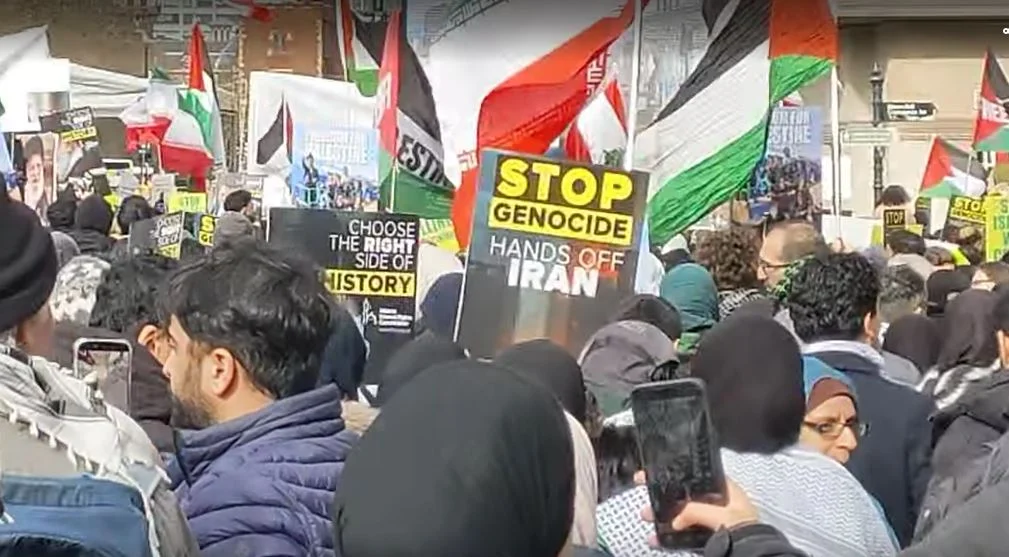
I crossed Vauxhall Bridge and then turned left along the Albert Embankment where it soon became clear that there was significant police presence which included loose cordons that protesters would have to pass through. Speeches were already under way emanating from a powerful sound system. Although the primary theme was Palestine, the situation in Iran ensured numerous visible Iranian regime flags.
On the opposite side of the Thames, it was obvious numbers had increased. ‘God save the King,’ could be heard with this distinctive version always including the second verse. Iranian monarchist flags could also be seen, however the numbers of counter-protesters totalled around meagre 300. There was a suggestion that a number of monarchists had opted to stage a protest outside the Iranian Embassy but that hasn’t been confirmed.
Numbers at the Al Quds protest were given as ‘hundreds’ by Al Jazeera and 15,000 by the organisers. The consensus as to a truer figure would be around two to three thousand.
The event wasn’t without incident. A journalist complained to police that her colleague was being assaulted. The officers intervened in what was a squabble that involved one pro-Palestinian activist who can be found at Palestine protests berating the opposition and police. On this occasion he could be heard shouting, ‘Are you a journalist’ at a male. All parties went their separate ways after the police stepped in. The journalist later claimed that police took no action.
The punk, rap singer Bob Vylan grabbed headlines with a speech that referred to police as ‘pigs’ and who then led a chant of ‘death, death to the IDF.’ His speech is currently being investigated by the Met.
Compliance with the 3PM finish
The conditions for both protests stipulated a 3pm finish and organisers duly complied. One group of males at the Al Quds protest became a little fractious and it seemed they were attempting to march which would have inevitably led to confrontation and arrest.
However, they were in fact ‘marching’ to their coach. There were several scuffles with police. A masked female was arrested as was a male ‘insert’ who was apparently shouting pro-Israeli slogans.
In total the Met made twelve arrests and there were no reports of officers being assaulted. Numbers attending were but a fraction of what had been anticipated by all parties involved. This may have been the direct result of the ‘draconian’ conditions imposed in that they acted as a deterrent.
There can be little doubt that both ‘venues’ are suitable for rival gatherings should a similar public order challenge occur again.
The previous day also saw protest activity which meant further abstraction of officers. The Iranian pro-Monarchists and their allies rallied again in Whitehall and then embarked on their well-trodden route to the Iranian Embassy. Numbers were not at the level previously seen, at around 2,000, but there was still plenty of enthusiasm for both the cause and Donald Trump despite the Minab school tragedy and the fact that relatives in Iran would understandably be concerned as to wayward air-strikes.
Also on Saturday was a pro-Palestine Friends of Al Aqsa gathering originally scheduled for Downing Street which would have coincided with the Iranian monarchist protest. The Met moved this to a separate venue opposite Parliament and in any event, just a handful of supporters materialised.
A successful weekend but disturbing workforce concerns
Thus, a successful weekend for the Met and it was good to see and speak to many familiar faces amongst the ranks of those involved in Sunday’s events. The conversations however were depressing and centred on officers leaving, planning to leave and low morale which mirrored the results of the most recent staff survey where 51% of those who responded said they intended to leave or were thinking of leaving. There was clearly huge mistrust of the current disciplinary process although all agreed that action needed to be taken against ‘bad cops.’
One officer, with ten years-service, told me that whilst she loved the job, she greeted every working day with apprehension in case she made a mistake which would end her career.
The consensus amongst everyone I’ve spoken to in recent weeks is that the Met is in a mess; that morale is on the floor and that no-one is listening to those at the ‘sharp end’ of policing. Perhaps this was best illustrated, on a day of large-scale abstractions for protest duties, by well-articulated concerns for those officers remaining on boroughs who were grossly and dangerously understaffed.
Loving the sense of humour of whoever decided to send West Midlands Police down to London for their expertise in public order policing of pro-Israelis. Old school. Unlike West Mids now.
Advertisement
Job of the week
DEPUTY COMMISSIONER OF POLICE
- Royal Cayman Islands Police Service
- Cayman Islands
- CI $121,356.00 – $155,316.00 per annum
The Deputy Commissioner of Police provides strategic leadership in support of the Commissioner of Police to ensure the effective management, direction, and oversight of the Royal Cayman Islands Police Service (RCIPS). The role is critical to advancing national security, enhancing public safety, and sustaining public trust across the Cayman Islands. The post holder is responsible for leading the development and execution of policing strategies, overseeing operational and organisational performance, and ensuring compliance with legal, ethical, and professional standards. The Deputy Commissioner also serves as the principal liaison with government entities, community stakeholders, and international partners, and assumes full command responsibilities in the absence of the Commissioner.
Read moreCoffee break