Article
Eyewitness: protest and counter-protest

Chris Hobbs attends a number of rival protests which highlight complexities that surround current international events that in turn impact upon front-line officers who have to make sense of it.
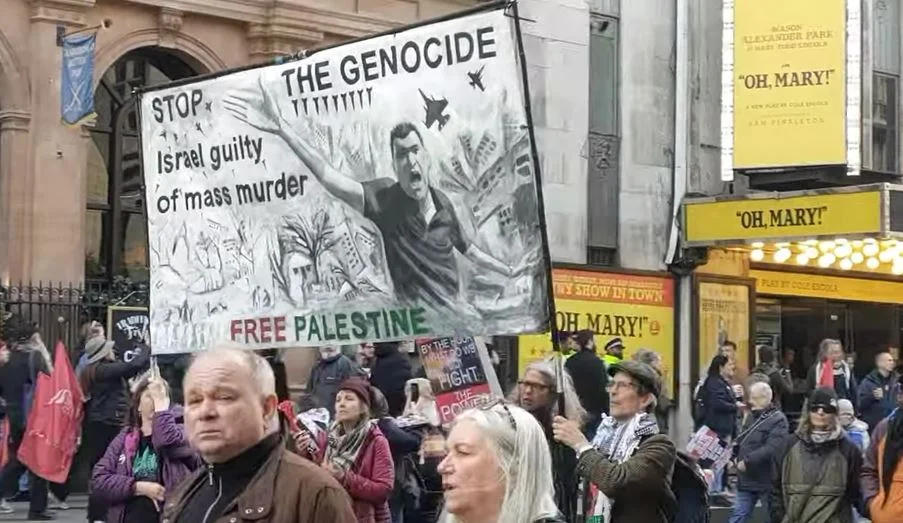
Saturday saw another major policing operation as a number of leftist organisations pooled their resources in order to stage a major anti-racist, ’Together Against the Far Right’ event. This was in response to Tommy Robinson’s Unite the Kingdom (UTK) protest back in September last year and his proposed controversial future UTK event on May 16th.
The march began in Park Lane and the huge queues for the public conveniences in Hyde Park was testimony to the organisers claims that the turnout would rival that seen back in September.
Whilst the main march was scheduled to begin in Park Lane, a sizeable ‘feeder’ pro-Palestine march would commence in the Knightsbridge area before joining the anti-racists.
Early tensions
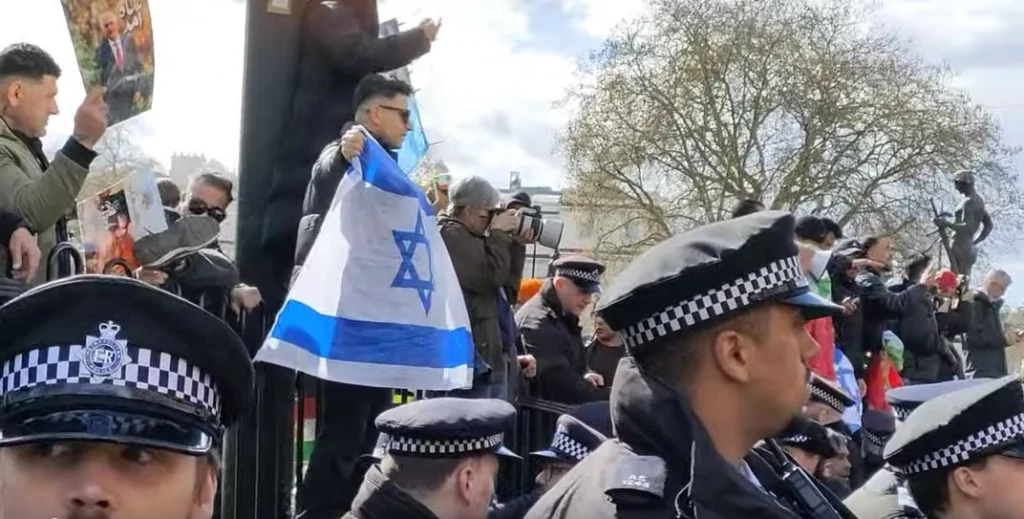
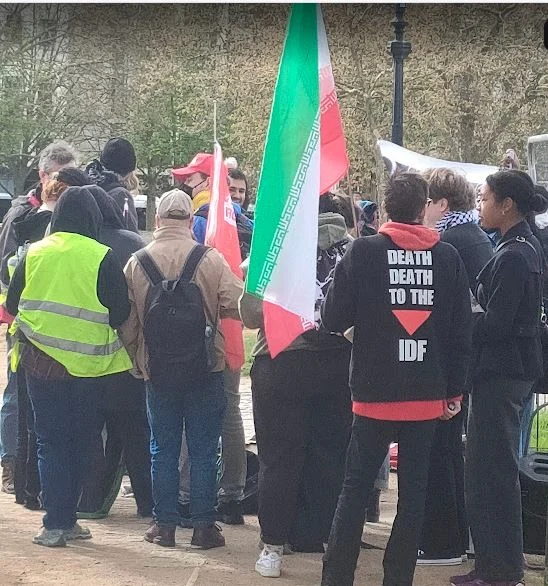
It wasn’t long before the main march ran into opposition, composed of a group that materialised in Hyde Park Corner and positioned themselves standing in front of railings on a raised wall area which resulted in police officers being rapidly deployed. These individuals consisted primarily of dissident Iranian pro-monarchists who hurled abuse at their rivals reserving particular venom for those marching under the flag of the current Iranian regime.
Had it not been for the rapid deployment of officers, such was the animosity generated, there would probably have been a physical confrontation. However, after half an hour, additional police officers moved the counter-protesters back behind the railings and the situation significantly eased.
At this point, I, somewhat guiltily, took an underground train to Piccadilly Circus. The march had already reached this landmark and indeed had progressed to the stage located in Whitehall. In Trafalgar Square, there was a linked ‘House against Hate’ music event. It was decided that the Square would be barriered off and those attempting to enter were shunted from entrance, to entrance by security personnel who seemed uncertain of their instructions.
Many participants, having reached their destination, headed for home but the marchers kept on coming in what was clearly a sizeable turnout.
In Whitehall, police attention became focussed on an incident that involved an individual previously acknowledged as Tommy Robinson’s number 2, who, in his role as a ‘journalist’ (everyone seems to be a journalist these days) was interviewing marchers, many of whom clearly knew who he was. In fairness the exchanges were both civilised and cordial with each side allowing the other to express their respective views.
Palestine Action
During the afternoon, I was informed that police were making arrests outside New Scotland Yard. By the time I took the various detours necessary to get there, the incident was over. It appears that 18 pro-Palestine activists sat down outside the building with placards suggesting support for Palestine Action. The Met had recently reversed its policy in respect of not arresting Palestine Action activists pending a judicial appeal concerning the decision to proscribe the group; these individuals clearly decided to put this to the test.
Journalistic licence
No group had apparently sought permission to stage a counter-protest but police were clearly on the alert for march opponents gathering and triggering disorder. The pro-Israeli Iranian dissident who frequently inserts himself in the midst of pro-Palestinian protests attempting to provoke a reaction, announced on social media, that he would be attending this protest as a journalist (as above).
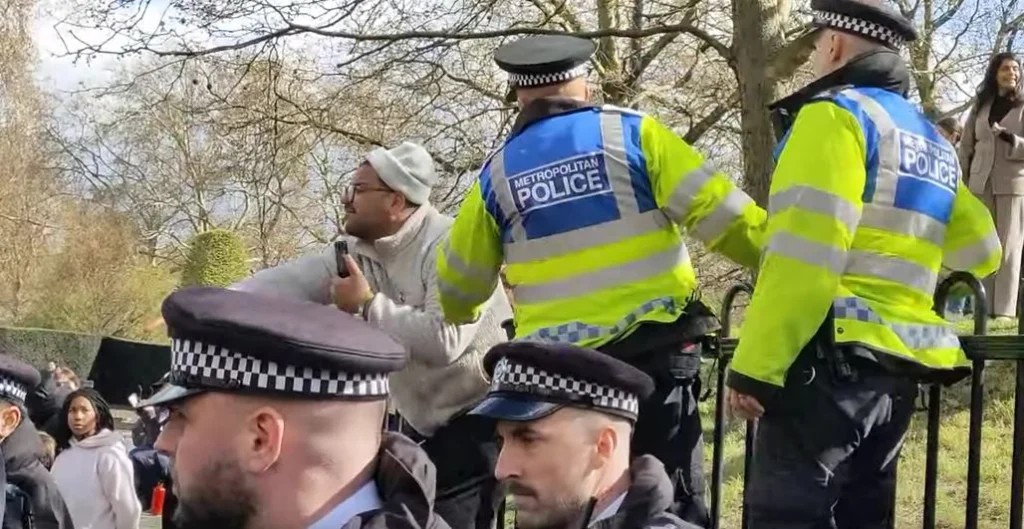
He was as good as his word and would be aware that probably just about every pro-Palestine activist could identify him; police yet again intervened thus prompting this individual to later state that he will be making a complaint. This was after he filmed himself attempting to interview those on the march, including pro-Iranian regime supporters and could be heard complaining that he’d been assaulted with a sandwich.
Further footage also emerged of familiar pro-Israeli inserts, police and angry pro-Palestinian marchers. Once again, such a scenario prompts the comparison of Arsenal fans demanding that they be allowed to mingle with Spurs supporters or that police permit West Ham fans be allowed to exercise their democratic rights and be allowed to mix with those from Millwall (this could become a reality next season).
Contentious scenarios
The decision to conflate this anti-racist march with the Palestine issue inevitably produced contentious scenarios. This was illustrated by a Jewish commentator known for his pro-Israeli views, attempting to join the march whilst carrying a placard stating, ‘I am a Jew, I hate Nazis:’ The point presumably being made here is that anti-racism does, as stated by the organisers, include antisemitism yet that issue, given recent events, appears not to have been worthy of meaningful inclusion during this protest.
The Met also had issues away from central London to deal with on this resource consuming Saturday. In Maida Vale, the pro-Iranian regime Mosque planned and held an event paying tribute to the deceased Iranian spiritual leader, Ali Khamenei. Pro-Monarchists turned up in numbers but there were no reports of disorder.
In Croydon, a rally by Nigel Farage attracted a protest of around 200 leftists including many who had travelled down from central London. Amongst the 200, were a group of around 60 ANTIFA activists who attempted to intimidate those entering Fairfield Hall and threatened a photo-journalist.
Complexities and confidence
This article features just a few of the complexities that surround current international events that in turn impact upon front-line officers who have to make sense of it all; those same officers will be only too well aware that each instant decision they make could result in a complaint that may well take years to investigate and ultimately result in them losing their jobs. There is little confidence in the current disciplinary system within the Met amongst serving officers who currently feel that in the drive to rid the organisation of undesirable individuals, the ‘baby is being thrown out with the bathwater.’
The numbers game
The question of numbers is always one which amuses seasoned protest observers with ludicrous figures being given by organisers on all sides of the divide. On this occasion it was announced from the stage that half a million individuals had participated; a clearly ludicrous figure. The Met have, for many years, not given statements in respect of numbers but on this occasion were quoted as saying that 50,000 had taken part. They would have had the National Police Air Service helicopter to assist them but despite this, I would have put the figure somewhat higher given the fact that a filled to capacity Trafalgar Square would have accounted for 20,000.
If the final figure was in the vicinity of 100,000 the Met could surely take even greater satisfaction from the fact that despite the tensions, the march and rally plus other events in the capital, passed off without any significant disorder.
Chris Hobbs is a former Special Branch officer who follows protests as an observer for Police Oracle.
Advertisement
Job of the week
DEPUTY COMMISSIONER OF POLICE
- Royal Cayman Islands Police Service
- Cayman Islands
- CI $121,356.00 – $155,316.00 per annum
The Deputy Commissioner of Police provides strategic leadership in support of the Commissioner of Police to ensure the effective management, direction, and oversight of the Royal Cayman Islands Police Service (RCIPS). The role is critical to advancing national security, enhancing public safety, and sustaining public trust across the Cayman Islands. The post holder is responsible for leading the development and execution of policing strategies, overseeing operational and organisational performance, and ensuring compliance with legal, ethical, and professional standards. The Deputy Commissioner also serves as the principal liaison with government entities, community stakeholders, and international partners, and assumes full command responsibilities in the absence of the Commissioner.
Read moreCoffee break