Article
Eyewitness: police ops succeed in keeping rivals apart

Chris Hobbs attends last Saturday's controversial Whitechapel counter-protest and the relocated UKIP protest.
Those emerging from Whitechapel Station on Saturday would have initially been greeted with a sight familiar to those who attend protests on a regular basis. Placards were being handed out together with leaflets and leftist newspapers by young activists and those of more mature years not unkindly referred to as ‘crusties.’
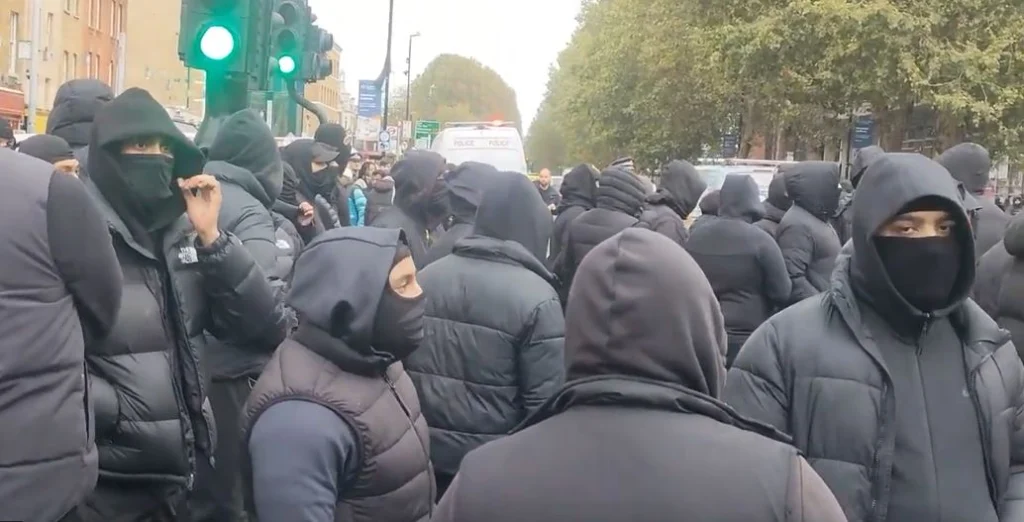
The famous Whitechapel market was in full swing but it soon became obvious that Whitechapel Road was closed to traffic. The road was blocked with protesters but, somewhat ominously, the Tower Hamlet’s Town Hall staps were occupied by masked youths dressed in black as was the immediate area in front of the building.
Further along the Whitechapel Road was a second gathering of what appeared to leftist anti-racist activists listening intently to impassioned speeches while, further along was a third gathering, possibly linked to trade unions and more speeches.
The reason for these gatherings was the proposed rally of UKIP activists whose advance publicity stated that their intention was to, ‘Reclaim Whitechapel from the Islamists.’ Quite how this was supposed to be interpreted remains unclear but the end result was that the Met effectively banned the Whitechapel protest and, using the provisions of the Public Order Act, relocated that UKIP protest to central London.
As the speeches were taking place a large group of around three hundred masked youths dressed in black appeared and began walking towards the Town Hall; their sinister appearance certainly attracted the attention of the other protesters.
When they reached the Town Hall, they made their way through the crowds of anti-racist protesters and their appeared little reproachment between the two groups; indeed, one clip on social media showed a white anti-racist shouting through a megaphone, ‘we’re with you bruv’ to those passing in black. The response was simply, ‘no you’re not.’
Whilst there was a visible police presence along the road, more police carriers complete with officers, were parked in side streets. All officers were ‘kitted’ which was a late change from the ‘day’ uniforms that were to be the order of the day.
It would seem that the masked youths who had been seen earlier ‘patrolling’ the area, were looking for any UKIP or far right activists. Video footage posted in the days before the protest, showed the Mayor of Tower Hamlets with a local social media ‘personality’ encouraging those watching to turn up to the counter-protest. In a second video posted together with the first, the local personality encouraged youths to purchase masks for the protest from his shop!
Clearly, word concerning the mode of dress for the protest had been spread effectively through the ranks of local East London youths of Bangladeshi heritage. Their objective was clearly to intimidate; however, the only likely visible and viable opposition were the police.
A potential clash avoided
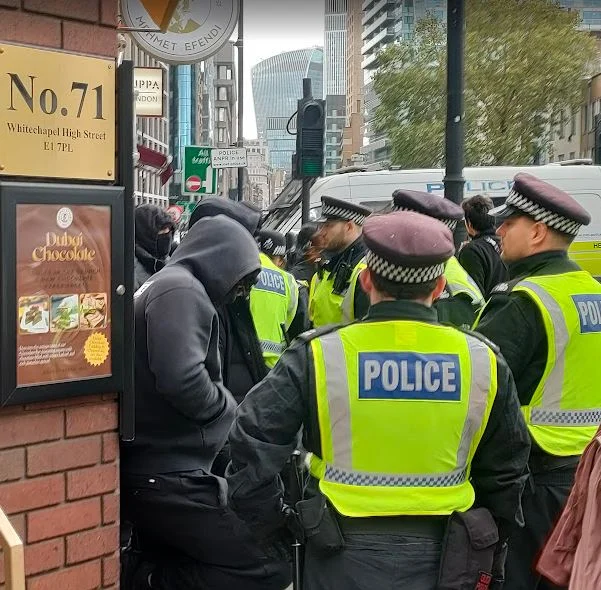
After the speeches, the youths congregated in the vicinity of the East London Mosque and, after being joined by other marchers, began walking in the direction of police carriers that had been loosely parked across the road.
The police reacted quickly; officers formed a cordon in front of the carriers which were joined by others and parked ready to move a few inches to go bumper to bumper, thus providing a near impenetrable barrier. However, members of the public were still able to pass to and fro. Those in an adjacent coffee and cake shop had a near perfect view of events.
The march continued to advance towards the police line but, amongst the protesters could be seen two police liaison officers in their distinctive blue tabards assiduously ‘working the crowd’ which included community leaders. The march halted and gradually began to disperse with a number of youths congregating in an adjacent park.
The only incident of note occurred when three youths attempted to pass through the police cordon. They were stopped and searched and one was arrested for possession of an offensive weapon; a bicycle chain.
With many of the youths in the park and a number of anti-racist protesters clearing up the discarded placards, the Whitechapel Road was re-opened to traffic. The market continued as it had done throughout the day; it didn’t blink.
Stallholders must, however, have been relieved that they had been spared a UKIP protest and counter protest. They may well have concluded that had the UKIP protest been allowed to proceed, their trading would have been ruined as the levels of violence would have been extreme and difficult for even large numbers of officers to control.
Speaking as a retired police officer who vividly remembers two serious albeit historic public order incidents when those perceived as far right, came to Southall, I can only endorse the decision made by the Met in respect of Whitechapel.
Years ago, I was a ‘probie’ officer at Southall when the ‘Blair Peach riot’ occurred. Police did not want the National Front to hold their meeting in Southall Town Hall but election regulations back then meant it had to go ahead. In the disorder, Blair Peach died allegedly as a result of being struck by an officer.
Three years later, unbeknown to police, a far-right music event was held at a local pub. The end result was that the Hambrough Tavern was effectively destroyed by fire as was a green police coach. Reports concerning the number of injured officers vary but were somewhere between 80 and 100; one of those injured officers was me, briefly knocked unconscious by a brick which resulted in a visit to hospital after reinforcements enabled police to regain control.
I had no desire to see history repeat itself in Whitechapel. Thanks to decisions made by the Met, it didn’t.
As it was, the main controversial issue of the day in relation to the policing operation concerned masked youths dressed in black with those on the right of the political spectrum complaining that police took no action and some stating that this ‘uniform’ breached the public order act.
The UKIP gathering
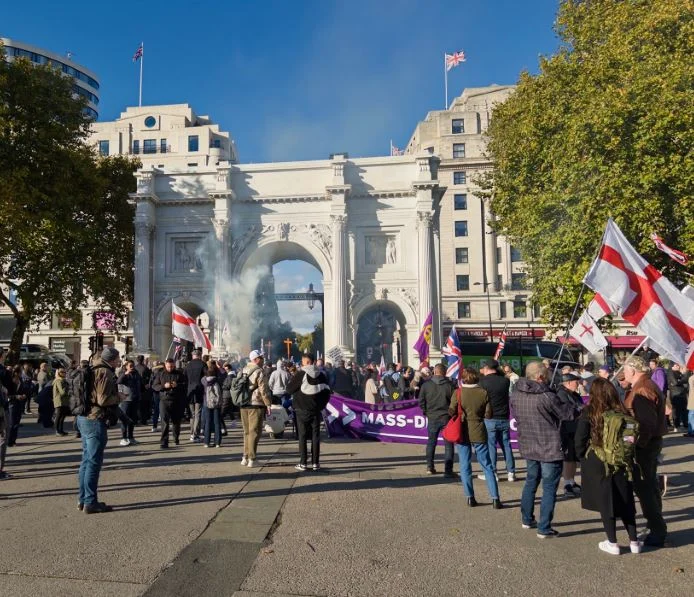
Photo: Crime Scene Images
UKIP met in the Brompton Road and numbering between two and three hundred, marched up to Hyde Park corner and on to Marble Arch. There were small groups of anti-racists loitering despite the conditions imposed by the Met and one incident involved a female throwing baked beans at a youthful ‘citizen journalist.’ The beans were not in a can and were not, apparently hot. The female fled and the victim berated police, angry that they had not chased the suspect. Neutral observers, however, stated that officers could not have witnessed the incident which caused a minor fracas. There still remain questions as to whether the ‘bean thrower’ breached conditions while the Met have asked the victim to contact them. The Met did later state that one counter-protester was removed from the area for breaching conditions.
Southampton’s anti-migrant march and rally
The Sunday saw an anti-migrant gathering in Southampton. The march, reportedly 600 strong, was uneventful until someone threw a bottle at the marchers from a pedestrian bridge. The small group scattered as angry marchers tried to break through their police escort and it appears Pava spray was used by officers.
The march continued and at the rally point police moved smartly to isolate a small group of individuals who were masked and dressed in black. Given the furore that surrounded the presence in Whitechapel of several hundred masked youths dressed in black, it caused a degree of surprise when it was discovered that these masked individuals were clutching union flag banners.
Thus, whilst the above-mentioned events concluded with no serious disorder, tensions across the country continue to rise exacerbated by the escape and recapture of and payment of £500 to the now deported Hadush Kebatu and the dramatic arrest of an Afghan migrant following the murder of a dog walker and further knife attacks on two others including a 14-year-old-boy.
Chris Hobbs is a former Special Branch officer who follows public order events for Police Oracle as an observer.
Category: Public Order
I do hope that the DEI obsessed senior officers have been boning up on their public order manuals and actually been attending some PSU training days. Because they are going to be having to get out of the office in the very near future and actually do a proper job.
Which feeds me with horror as many of them will freeze like bunnies in the headlights when faced with dealing with a fast evolving public disorder and having to make actually decisions.
I can remember from my day watching them fail badly on regional PSU training days and I suspect that they have not improved since I retired.
They haven’t, Paul. Any officer above the rank of Inspector, rarely the occasional Chief Inspector, should not be anywhere near operational decisions on the street. Inexperience is a huge problem across the whole of policing. Nowhere is this more apparent than in public order policing.
Advertisement
Job of the week
DEPUTY COMMISSIONER OF POLICE
- Royal Cayman Islands Police Service
- Cayman Islands
- CI $121,356.00 – $155,316.00 per annum
The Deputy Commissioner of Police provides strategic leadership in support of the Commissioner of Police to ensure the effective management, direction, and oversight of the Royal Cayman Islands Police Service (RCIPS). The role is critical to advancing national security, enhancing public safety, and sustaining public trust across the Cayman Islands. The post holder is responsible for leading the development and execution of policing strategies, overseeing operational and organisational performance, and ensuring compliance with legal, ethical, and professional standards. The Deputy Commissioner also serves as the principal liaison with government entities, community stakeholders, and international partners, and assumes full command responsibilities in the absence of the Commissioner.
Read moreCoffee break