Analysis
Eyewitness: With November 20 days away, the Met’s changes to public order policing evolve

The Commissioner’s decision to reduce and, in some cases, remove police coverage of public order events was evident again during recent protests. The objective appears two-fold; to save money and to reduce the number of abstractions from local borough policing. Chris Hobbs reports.
Some have interpreted this as a form of ‘industrial action’ designed to focus the minds of those in government who hold the purse strings, yet this policy comes with obvious risks.
At a recent pro-Palestine protest in Whitehall, on the evening of the 26th of Oct, where no police were present, there was a small confrontation resulting in allegations of religiously aggravated assault from rival individuals. A number of pro-Palestinians then obstructed traffic in Whitehall and Trafalgar Square. It wasn’t certain at that time whether this was as a result of the Commissioner’s new policy or because police resources were redirected to disorder at the Ballon d’Or presentation taking place at the Palladium Theatre near Oxford Circus.
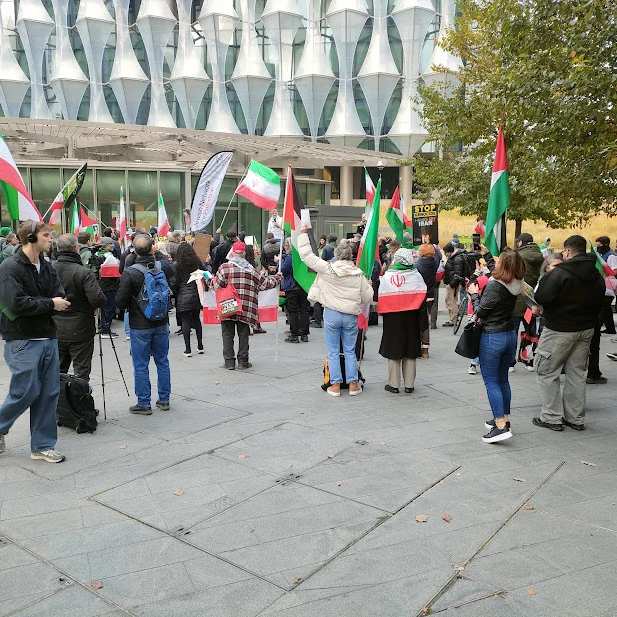
Iran protest at the US Embassy
On Saturday, November 7, a protest took place at the American Embassy due to concerns that the USA were about to launch attacks upon Iran itself. The crowd, complete with Iran regime flags, numbered around 100 and was watched over by two local officers. There were no incidents, and opposition in the form of anti-regime, pro-Iranian monarchists didn’t materialise. It may have been the case that the Met’s public order branch had already obtained assurances that there would be no rival demonstration.
‘Emergency’ protest targets the Israel Philharmonic
On November the 10th, the evening appearance of an Israeli orchestral ensemble, drawn from the Israel Philharmonic Orchestra, at the British Library resulted in an ‘emergency’ protest called by pro-Palestinian groups.
There was a degree of speculation as to whether this would be policed, but the diplomatic fallout resulting from disruption by pro-Palestinian activists due to police ignoring the event would have been significant, to say the least.
As I arrived, I noticed the presence of three Territorial Support Group carriers together with several other units. The pro-Palestinians numbered around two hundred and were separated from the British Library by the effective barrier of a very busy Euston Road.
About forty pro-Israeli activists were located in a side road off the Euston Road and adjacent to the British Library. Some were later to complain that the pro-Palestinians were in ‘pole position ’, being very visible to passing pedestrians and motorists. Conversely, the Met would doubtless argue that those attending the function would barely have been aware of the presence of that rival protest which was safely contained.
Remembrance Events
During this early November period, Remembrance events took place across the UK and beyond. At my own local Remembrance service in Ealing, there was, as in previous years, a police presence and, revised policy or not, the Whitehall service took place amidst strict security.
There was also a visible police presence at the Whitehall ceremony on November the 11th and no incidents were reported at the traditional Jewish Remembrance event which is held in Whitehall a week after Remembrance Sunday itself.
The unpoliced Palestine emergency meeting
The next test of the Met’s resolve in respect of its public order ‘cost cutting’ occurred on November the 13th when pro-Palestinian groups called for yet another ‘emergency meeting’ to be held outside the Foreign Office to demand “UK sanctions” against Israel, a full arms embargo, and immediate humanitarian aid access to Gaza.
This would appear to have been triggered by the torrential rain that effectively flooded Gaza, with the Israelis subsequently refusing to allow aid convoys to cross the border.
The gathering was actually in Whitehall at the junction with King Charles Street and about 200 protesters turned up. The rally attracted the brief attention of two police officers but continued unpoliced. At the conclusion of the speeches, most participants left for home, but a youthful group of around 50 went into the road and began an illicit march up Whitehall towards Trafalgar Square. This obstructed traffic, with buses and other vehicles compelled to follow at a snail’s pace.
The march turned right into Horse Guards Avenue and then right onto the Victoria Embankment again, impeding traffic. Their route took them to New Scotland Yard where, predictably, they stopped again, blocking traffic which responded with a cacophony of irate horn-sounding. Some vehicles attempted to work their way around the group, and the irony of an illicit march blocking traffic outside the headquarters of the UK’s major police force was not to be lost on many.
Westminster Bridge and the arrival local officers
The march eventually moved off and made its way onto Westminster Bridge and, when halfway across, stopped completely, blocking traffic apart from those on pedal cycles and e-bikes who were able to proceed.
After a short while, a local Met police response vehicle appeared, and one officer attempted to locate whoever was leading the group. It would seem that the officers had come across the incident as opposed to responding to it via the Met’s Command and Control.
The presence of one vehicle and three officers appeared to unsettle the crowd, who moved off and then went down the steps to the pedestrianised South Bank; the traffic duly began moving again.
A second Friday the 13th protest
This, however, wasn’t the only public order event of the night; another protest was taking place on the Fulham Palace Road outside a restaurant owned by a Sikh.
Back in February, the restaurant owner, Harman Singh Kapoor, posted a notice on his storefront stating, ‘Proudly we don’t serve Halal.’ This prompted a hostile reaction and the beginning of a saga that has stretched over many months and is too detailed to be chronicled here.
Suffice it to say a war of words, which has included physical threats, has duly followed, with pro-Palestinian and leftist protests taking place outside the restaurant; during this period Mr. Kapoor has been accused of Islamophobia. He has not been without support from those on the British right, including Tommy Robinson and indeed from pro-Trump activists in the USA.
Mr. Kapoor would appear to be currently under investigation for posting an allegedly pornographic cartoon on social media that is being interpreted by some as Islamophobic. He has also been critical pf police for allegedly failing to protect himself, his family and his business.
As an aside, the Sikh Press Association has recently issued a statement which is critical of Mr Kapoor, and it would seem that this saga will continue for the foreseeable future.
In any event, Friday’s protest at the restaurant was policed; part of the Commissioner’s strategy would now appear to be that much public order policing would come under the umbrella of localised Basic Command Units.
It remains to be seen whether this revised model of public order policing will continue: Serious injury to a police officer or member of the public as a result of the under policing of a public order event may cause this policy to be revised.
Friday’s Gen Z nationwide protest
However, new policy or not, there is no doubt that police resources will be present in abundance on Friday when nationwide ‘Gen Z’ protests, which are attempting to emulate events in France and elsewhere in Europe, are due to take place across the country.
Police commanders will be hoping that advance publicity won’t tempt lawless elements onto the streets and pupils away from schools in order to reinforce students and political groups who are instigating these protests.
Another complication could involve far-right groups who may also take to the streets in opposition. This would be despite appeals from some on the political right to stay away based on the premise that violence will result in the radical left shooting themselves in the foot.
As alluded to above, Friday’s protests are not merely scheduled for London but are due to take place across the country, which may well have an impact on the ability of forces to provide aid (assistance) to others.
This, potentially, may be the biggest challenge faced by UK police forces since the post-Southport riots of 2024. Those with a more positive attitude will point to the fact that despite extensive media coverage of the serious disorder across Europe, such disorder that has occurred in the UK has been around the traditionally problematic dates of Halloween and November 5.
In London, police will be concerned as to whether ‘striking’ pupils will leave their schools at lunchtime and, if they do, whether any subsequent disorder will take place locally or as the result of a mass commute into central London. Similar issues may well impact upon other forces across the UK.
Those policing these events will also be concerned that, in the event of violent disorder, any use of force by officers may result in them being ‘thrown under the bus’ and subject to investigation that could last for years.
Advertisement
Job of the week
Investigations Manager – Economic Crime and Confiscation Unit
- The Government of Jersey | HM Attorney General
- Jersey
- £112,690.56 to £124,480.88
Jersey’ Attorney General is seeking to appoint an Investigations Manager within the Economic Crime and Confiscation Unit (ECCU) at the Law Officers’ Department in Jersey. This is a unique opportunity for an experienced investigator with a substantial background in policing or other investigative criminal justice role, to lead a team of investigators within the unit, which focusses on the significant risk of economic crime to Jersey, and prosecuting complex international financial crime and money laundering cases. The successful candidate will possess exceptional investigative skills, together with extensive expertise in all aspects of financial crime investigation.
Read moreCoffee break