Article
Eyewitness: trouble in the West End and elsewhere

Chris Hobbs reflects on another difficult week for policing.
(PHOTOS: Paul Brown (apart from Ealing Broadway Tube pic)
The World Cup, as expected, saw public order repercussions for policing in UK, but other issues still had to be dealt with by an increasingly beleaguered police service.
As far as the World Cup was concerned, policing those who took to the streets in the aftermath of defeat or victory was always going to be a challenge. Just over a week ago, I commented on those who criticised a Met response crew of two who failed to leave their vehicle and deal with a good- natured group of Moroccan supporters celebrating their team’s victory,
Less good natured was the disorderly behaviour of Egyptian supporters after celebrating their team’s victory in an earlier round. Thus, there was a strong police presence around the Edgware Road after Argentina eliminated Egypt from the competition. At the final whistle, I quickly made my way from home to the West End to find that the police presence had virtually gone and the Egyptian fans were dispersing peacefully.
Moroccan fans and far-right allegations of police cowardice
The next day Morocco played France and, I confess, had I been completing the threat assessment, I probably would have concluded that a minimal police presence would be required. I failed however to research what was the abysmal behaviour of Moroccan supporters in other European cities over recent years.
Morocco lost and subsequent events in and around the Edgware Road resulted in a feeding frenzy by those on the far right. Whilst I, as a result of my own flawed risk assessment, wasn’t present, others were and one segment of footage was seized on by police critics which purported to show Met officers ‘running away’ from ‘Muslim rioters.’
I originally understood this to be officers running to support their colleagues but whilst those beleaguered colleagues will have been pleased to see them, the facts of the incident later became apparent. Those featured in the clip were Level 3 public order trained officers. All Level 3 officers are trained to a basic standard but would not ordinarily be deployed to public order events that could prove problematic and/or challenging. These events would be policed by Level 2’s and Level 1’s whose public order training is to a higher level. Most Level 1’s in the Met would be specialist Territorial Support Group officers.
Level 3’s under attack
This serial of some 22 Level 3 officers were almost certainly deployed in order to keep the roads clear and to establish an amicable working rapport with any crowds that materialised. In fact, within minutes of Morocco’s defeat, they became cut off by large hostile crowds numbering several hundred who began bombarding them with missiles and fireworks.
A sergeant responsible for the serial decided that, without access to any protective equipment, they had to make a run for it as to remain in situ would have placed the officers at risk of serious injury or worse. Thus, going viral upon social media, was footage of the twenty-two officers running through the considerable crowds in order to link up with their colleagues. It would seem that this course of action took those who had become a mob, by surprise and the Level 3’s made it to safety.
Officer down, ‘riot gear’ donned and the mob cleared
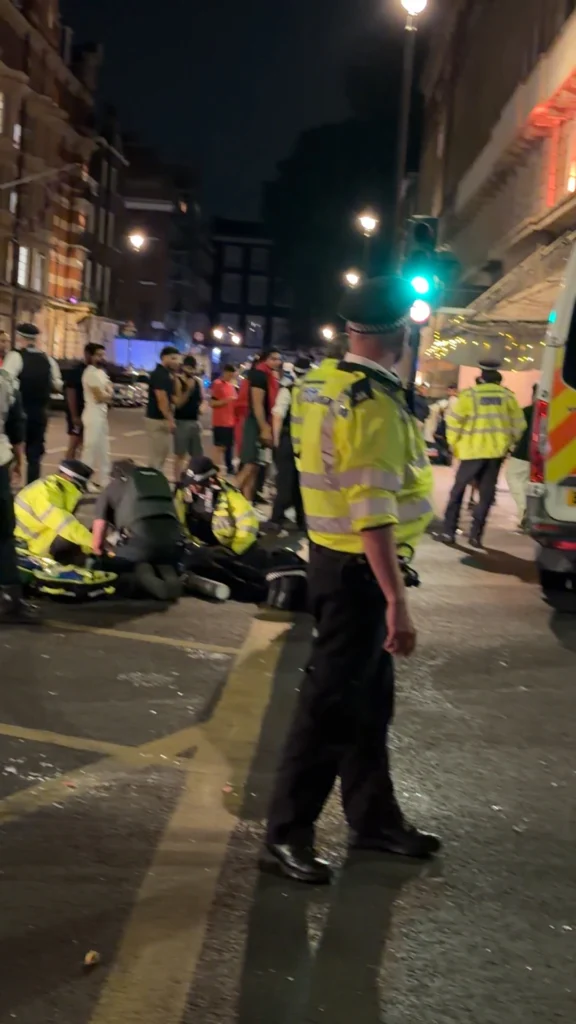
The Level 2’s present were also coming under attack and one officer caused considerable concern when he became unconscious having been struck on the head by a missile; to the consternation of his colleagues, he remained unconscious for a disturbing period of time. Paramedics attended the volatile scene and the officer was conveyed to hospital where he made a full recovery.
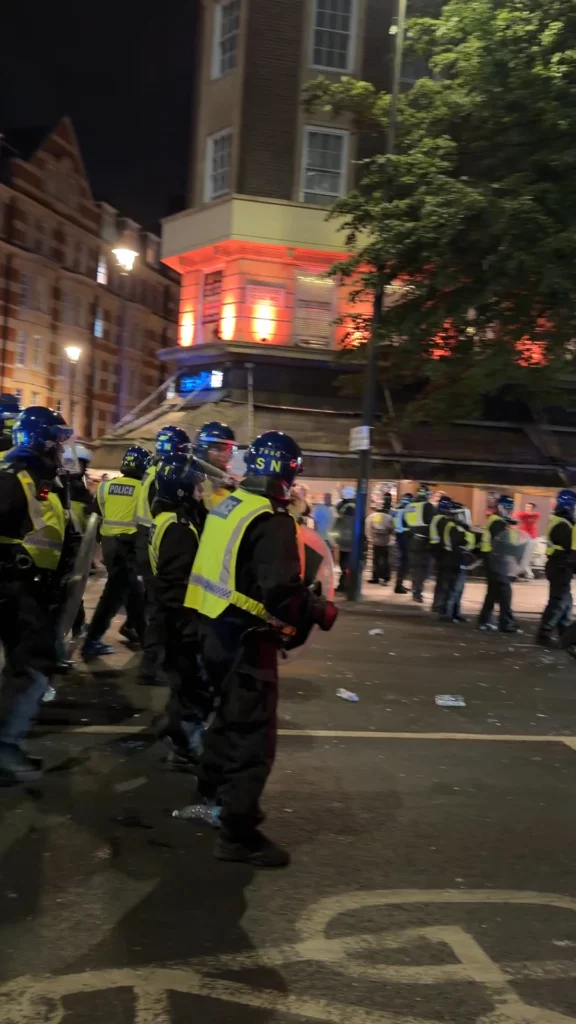
As this incident was unfolding, Level 2 officers had been instructed to don full Personal Protective Equipment (PPE) which meant changing into ‘riot gear’ whilst attempting to avoid bottles and other missiles landing in their midst.
Officers, complete with ‘short shields’ and with reinforcements then began to firmly clear the area of crowds described in many posts as rioters.
Unchallenged social media allegations
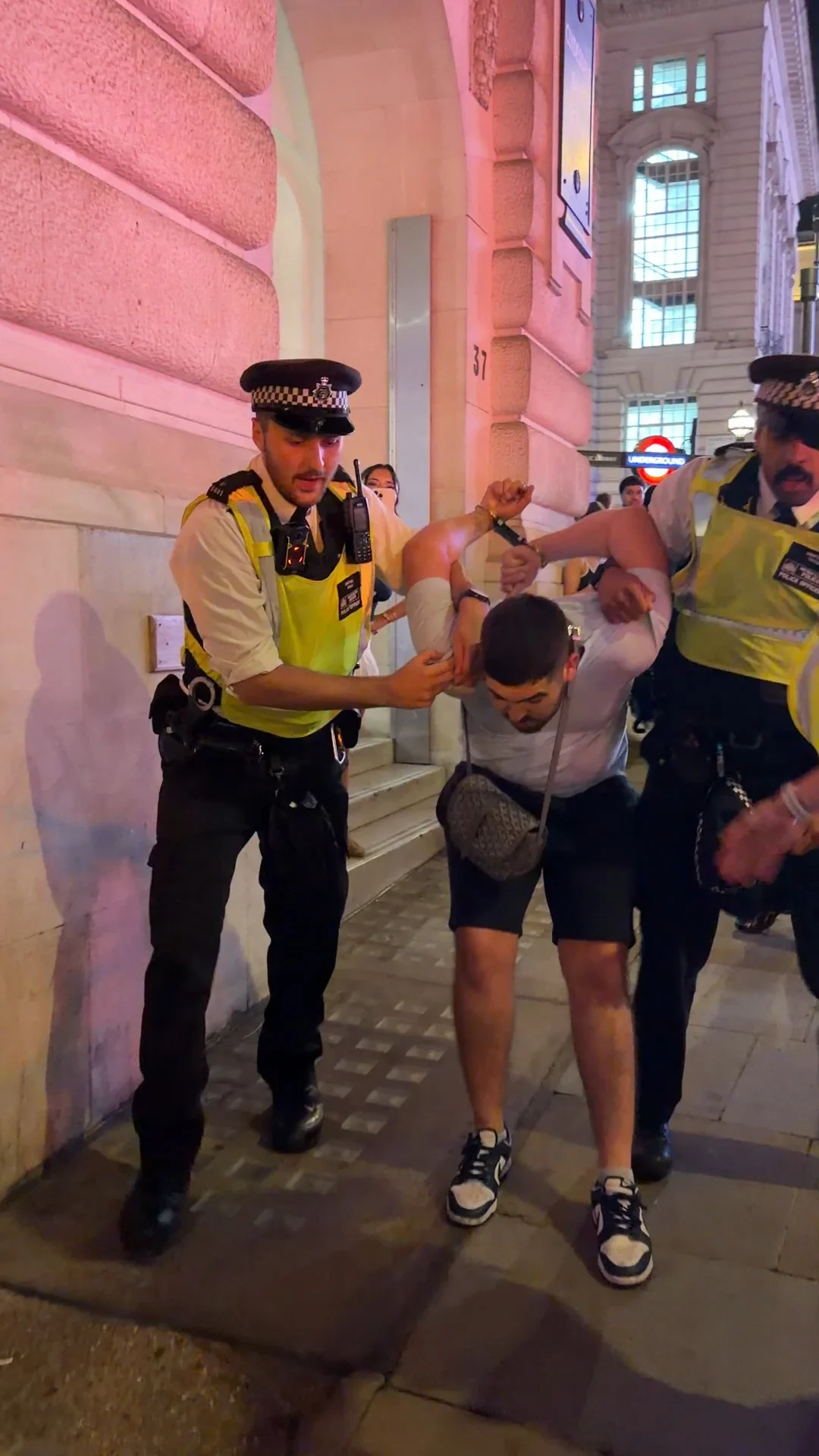
However, as far as police critics on the far right were concerned, the footage of running officers merely illustrated the fact that officers were cowards running scared of Muslim mobs. There were also suggestions that England fans would have been subjected to far harsher treatment.
The following morning, whilst Deputy Commissioner Matt Jukes referred to the incident when being interviewed on LBC and there was a report on BBC News, allegations concerning cowardly, two-tier policing were gaining tens of thousands of views and disparaging comments on ‘X.’ I sent the relevant footage to the Met who promptly responded stating that the Met’s Press Bureau were already aware.
There was however no clarifying post on ‘X’ or elsewhere as to what had actually occurred on the night in question; the myth of cowardly officers running from ‘Muslim mobs’ remains and will be resurrected periodically over the next few months and years.
This incident was frequently featured in tandem on social media with an public order confrontation in the Cranfield area of Glasgow where police had to escort two individuals from an apartment building through a violent mob who believed they were paedophiles. Police were criticised for protecting these individuals; presumably officers should have stepped aside and allowed them to be beaten to death. At least two other similar incidents were reported in the city.
Social media then contrasted police using force to protect sex offenders from an angry public whilst running away from Muslims.
The aftermath of England’s victory against Norway saw large crowds take to the streets of central London. The mood was generally good natured with just seven arrests but it did prompt the question as to possible future public order challenges in the event of an England defeat.
Meanwhile in West London
During this period, I also experienced ‘law and order issues’ which may be considered trivial in themselves but perhaps illustrates the mire into which we appear to sinking. In the W13 area of London, I queued at a fruit stall just off the Uxbridge Road and the gentleman in front of me was approached by a known ‘substance abuser’ who showed him the contents of a carrier bag. The male shook his head and the individual walked off. When it was my turn to be served, I asked the young guy serving what the situation was like on this apparently insignificant road. He vividly described being plagued by anti-social behaviour and theft.
The next day I returned and went to what is best described as a traffic free precinct just along from the road I purchased fruit from the previous day. The picture painted was even more horrific with traders being plagued by crime and anti-social behaviour. ‘We call 999 but they never turn up,’ was a complaint and as I was being told this, several of the miscreants were assembling on benches and included the substance abuser from yesterday.
Sainsburys, located in this area, is a prime target for crime although the store management may not admit there is an issue. Apparently, a popular security guard was assaulted just days previously. I was also told of an incident the evening before where an individual had approached two females on separate occasions and told them he would like to ‘rape them.’
Two 999 calls were made but there was no police response. Colleagues of one of the females told me that she was asked to remain at the location and police would be there in around twenty minutes. The victim didn’t wait as she felt unsafe. Local traders did manage to obtain a photo of the suspect.
Following my self-initiated enquiries, I began to walk home along the Uxbridge Road. After around a hundred yards, I head sounds of disturbance emanating from a small vape and newspaper shop on the opposite side of the road. A skinny, black male was berating the Sikh shopkeeper. Such was the level of animosity that I crossed the road and pulled out my phone dialling 9 twice.
The man came out still hurling abuse that appeared linked to money he was owed for a power bank which perhaps tells another story. I pointed out to him that I was about to hit the third 9 which generated further abuse. He crossed the road came back, threatened me and then moved on to two ladies sitting at a bus stop demanding that they give him £2. One was elderly; one disabled and both refused. He then walked down a side road which, as I later discovered, contains some sort of hostel for those with mental health and/or drugs issues.
By this time, I’d opted to dial 999 and spoke to a very pleasant police call-handler who spent about ten minutes recording my details and details of the incident. I wasn’t expecting an immediate response and was later sent a text with a CAD (call) reference telling me that it had been graded as an ‘S’ call. I was later informed that a unit did attend an hour later but, unsurprisingly the result was no trace.
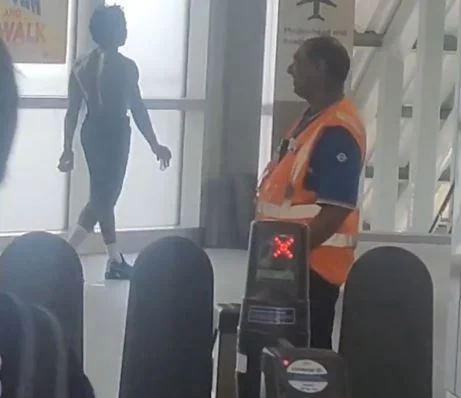
Later that week, I took a short trip on the ‘Lizzie Line’ to Ealing Broadway station and as I approached the ticket barrier, I noticed a bare- chested youth approaching the same barrier from the other side. He was dressed only in shorts and trainers and I turned around to watch with interest after I’d passed through. It came as no surprise when he vaulted the barrier with ease and continued on his way as a staff member watched. Staff members are of course, forbidden from tackling fare-evaders.
Local policing.
During the same week, I attended a scheduled a local ward panel meeting with our excellent local policing team. I opted, reluctantly, to catch a bus along the Uxbridge Road and encountered the world’s most bad-tempered driver.
During the ward panel meeting we heard of some excellent work being carried out by our local policing team (LPT). This included the imprisonment of several ‘commercial robbers;’ those individuals who generally ‘mask up’ and use significant violence, often involving weapons, in order to steal relatively high value goods such as bottles of spirits. I was also able to convey favourable comment from friends of mine who organise a major local carnival. The LPT had several issues to deal with during the course of a successful afternoon attended by around 20,000 people and dealt with them well.
I then held centre stage in respect of the local issues referred to above. I was surprised to be told that most the contentious areas of concern I referred were literally on the very edge of this team’s ‘ground’ and was the responsibility of another local policing team.
I was even more surprised to discover that my own LPT consisted of just one sergeant, two constables and one community support officer; woefully inadequate to fully meet the challenges of the area which now includes a youth gang terrorising a local estate.
I tend now to ask, when entering smaller convenience stores, how many ‘shoplifters’ they’ve had in thus far on that day. It’s rare that I receive a negative response.
A war of words that is being lost
Perhaps of greater concern is the current tidal wave of animosity shown towards police. On the same day as Moroccan supporters provided those on the far-right with more ‘brick-bats’ to throw at the UK’s police service, a short distance away the police bravery awards presentation evening was being held at Downing Street yet, despite the best efforts of local police federations, it was ‘police cowardice’ and ‘two-tier’ policing which dominated social media.
Social media, notably ‘X’ is becoming hostile to police officers to the extent that their safety is being imperilled. Posts are now actively encouraging violence against officers and the failure of ‘police comms’ to counter fabricated or totally exaggerated allegations places those on the front line at risk.
Organisations such as the National Police Chiefs Council, the College of Policing and senior police chiefs could and should be drawing attention to what is clearly a current campaign, not merely to undermine police but to provoke civil disorder on a scale that would be unprecedented and could even be defined as an insurrection.
Chris Hobbs is a former Special Branch officer who follows public order events for Police Oracle as an observer.
Sorry you are weeing into the wind!! The powers that be gave up on basic policing years ago. I am sure that everyone reading this article can recount watching similar incidents occurring in front of them. Stores that have given up ringing the police when the feral space cadets are rampaging through the store nicking everything with almost total immunity. The groups hanging about town centres off their heads by the middle of the morning. pestering shoppers etc for money etc. Where is the bobby on the beat? Gone replaced if at all with the chocolate teapots PCSO’s who the scrots know have zero powers to effect them. I can not remember the last time I saw a uniformed Pc walking through my local town centre.
Officers back in my day would have dealt with them and if necessary nicked them, took them into the police station and would have processed the arrest interview if required and the file done before the meal break.
Not on any more. My old force has closed all its county custody suites. We have three all in the city. There is a travel time of sometimes over an hour one way from the outer towns into the city. Then the time to just get the prisoner booked in and processed. You can forget doing anything else that day. Overtime in order to finish off dealing with the prisoner or handing it over to the next shift. Then waiting for Couldn’t Prosecute Satan to authorise the charge.
There is no one left in service who can remember the job pre PACE 1984 and sadly the current generation will never know how much better it was back then.
Advertisement
Job of the week
Police Sergeant – Ascension Island

- Ascension Island Government
- Ascension Island
- £23,968.00 per annum plus food and utilities allowances, free housing and other benefits
This is a unique opportunity to take on a key operational role within the Royal St Helena Police Service on Ascension Island. Working closely with and supporting the Police Inspector, you’ll help provide effective day-to-day supervision, maintain high professional standards and ensure the team delivers a responsive and community-focused policing service. You’ll be a visible and approachable presence for both colleagues and the wider community, offering guidance, making sound operational decisions and helping officers develop their skills and confidence. This is a varied, hands-on role for an experienced Sergeant who enjoys supporting leadership, strengthening a team and making a genuine difference within a close-knit island community.
Read moreCoffee break