Article
The UKIP protest, a distasteful banner and the public response to tragedy

Chris Hobbs follows a UKIP protest and witnesses a distasteful anti-police demonstration by one individual.
As a prelude to the Notting Hill Carnival, the Met also had to deal with a proposed UKIP march and rally on the Saturday which prompted an inevitable counter-protest by Anti-racist groups. UKIP originally wanted to march down the Edgware Road to Marble Arch which could have prompted a violent reaction from those who live and work in the area.
This resulted in the Met imposing conditions which, according to the somewhat scruffy maps posted on social media, seemed to indicate that UKIP should assemble in the vicinity of Wellington Arch before marching along Piccadilly towards their eventual destination of Whitehall, opposite Downing Street.
Chanting anti-racists assembled just outside the gates of Hyde Park and then, numbering about 150, moved just inside the park. A handful of UKIP protesters could be seen gathering near Wellington Arch and there was a substantial police presence.
Suddenly, and taking everyone by surprise, around 100 UKIP activists appeared inside the park marching purposely towards the gates which would enable them to meet up with the fellow protesters by Wellington Arch. This took them on a collision course with the anti-racists who promptly swarmed the UKIP contingent.
Scuffles
Chaos ensued with lots of pushing and shoving as the two sides ‘mingled.’ Whilst it looked alarming, in fact very few punches and kicks were exchanged as police rushed to break up the melee. TSG officers, whose carriers were parked just outside the gates, were quickly deployed and the UKIP contingent were moved through the gates.
A short distance from the gates a megaphone was produced and the UKIP leader claimed they had obeyed conditions imposed upon their group whereas the anti-racists had not and had not been subsequently arrested.
The anti-racists stayed in the park and then, to everyone’s surprise, marched off as a group through the park towards Marble Arch followed by a number of police. Equally surprising was the fact that they were not seen again that day.
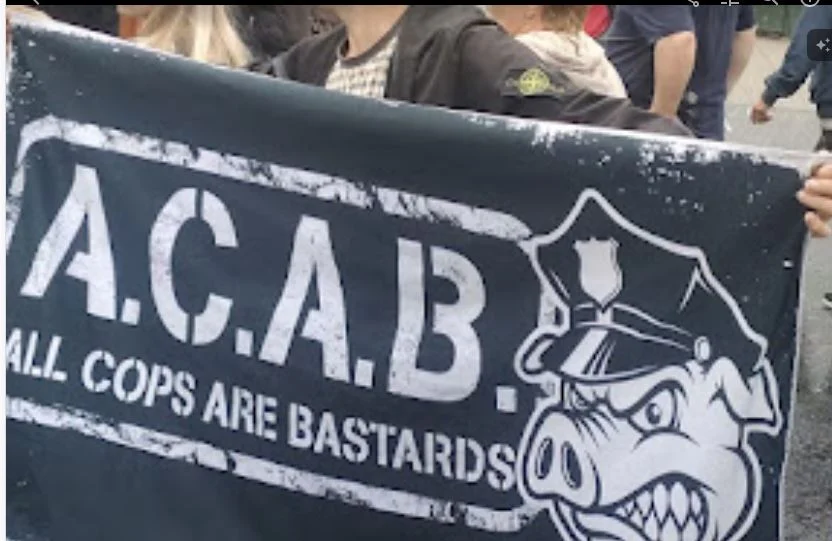
UKIP eventually formed up and, about, 100 strong began to march along their allocated route. The attention of the press was, however, captured by an individual who unfurled a banner that was especially distasteful given the fact that just seven days had elapsed since the two Cleveland officers had been killed on the A66.
The march reached Whitehall without further incident and a rally was held opposite Downing Street. There were just a handful of anti-racists present and the only incident occurred when one individual was told to remove his mask. He claimed he was ‘immunocompromised’ and refused to remove it. He then apparently theatrically collapsed and remained flat on his back gazing at the heavens before the arrival of prisoner transport.
The rally concluded and once again the banner referred to above was again unfurled and displayed. It may well be that the UKIP hierarchy were unaware that this banner was being displayed effectively, in their name: It does however, pose questions as to the reaction of certain politicians to the A66 tragedy which resulted in the needless deaths of PC’s Mathew Blades and PC Tom Clough. Reform’s Zia Yusuf did comment movingly about the incident but was criticised for waiting three days before speaking out.
However, as far as can be ascertained, there have been no significant public statements from Reform’s Nigel Farage or Richard Tice; Restore’s Rupert Lowe or UKIP’s Nick Tenconi.
Other politicians have been criticised for linking sympathetic comments in relation to both the two officers and the five responsible for the catastrophe.
Certain politicians would be well advised to ‘read the room’ as far as policing is concerned. There is no doubt that policing is ‘troubled’ at this moment in time thanks to decisions made by politicians and very senior officers over many years. This is compounded by distortions seen on both mainstream and social media. Yet despite this, the petition not to ‘early release’ PC Andrew Harper’s killers reached a remarkable one million signatures.
The above- mentioned deaths of the two Cleveland officers also witnessed a remarkable response from the public with over one million pounds being raised.
Perhaps what is needed now is for each and every police force in the UK to look at its communication strategy with the public and examine how to keep that public informed of the numerous examples of excellent police work that can be seen across the country over each and every 24 hours.
Chris Hobbs is a former Special Branch officer who follows protests as an observer for Police Oracle.
Category: deaths on dutyPublic Order
Advertisement
Job of the week
Police Sergeant – Ascension Island
- Ascension Island Government
- Ascension Island
- £23,968.00 per annum plus food and utilities allowances, free housing and other benefits
This is a unique opportunity to take on a key operational role within the Royal St Helena Police Service on Ascension Island. Working closely with and supporting the Police Inspector, you’ll help provide effective day-to-day supervision, maintain high professional standards and ensure the team delivers a responsive and community-focused policing service. You’ll be a visible and approachable presence for both colleagues and the wider community, offering guidance, making sound operational decisions and helping officers develop their skills and confidence. This is a varied, hands-on role for an experienced Sergeant who enjoys supporting leadership, strengthening a team and making a genuine difference within a close-knit island community.
Read moreCoffee break