Article
Eyewitness: red flags, scuffles and discontent
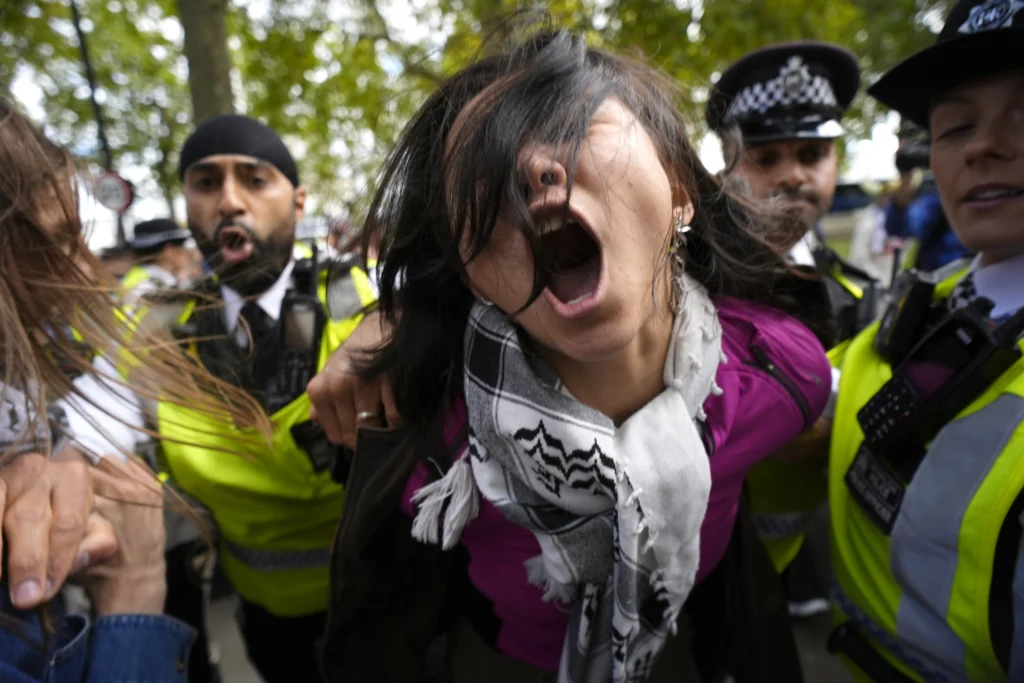

Chris Hobbs attends a Palestine Action protest where incidents during the day were punctuated by tales of poor morale amongst the ranks of the Met and officers leaving or intending to leave.
For those who regularly attend protests, hearing criticism of from organisers is a regular occurrence. Saturday was no exception as the Palestine Solidarity Campaign took to the streets for the thirty-something time.
Before the march had even set off, pro-Israelis under the ‘Stop the Hate’ banner were chanting; ‘Met Police do your job.’ In the aftermath of the protest, those on the political right who dislike the term far-right, were accusing police of failing to protect a national monument from Communists while those on left accused police of brutality during disorder in the vicinity of that national monument.
Incidents during the day surrounding the protest were punctuated by tales of poor morale amongst the ranks of the Met and officers leaving or intending to leave.
On Saturday events began with the gathering of thousands in and around the Embankment Station for yet another Palestine Solidarity Campaign march and rally. In fairness, despite the hype from critics, these events have seen very few incidents of ‘physical disorder’ or to put it another way, very few bouts of fisticuffs. Most arrests have been in relation to actionable placards or chanting.
This event took place against the background of the controversial march by pro-Palestine students on the 7th of October which attracted barely 100 participants together with a counter-protest. In total eleven arrests were made at this rather chaotic event and other protests during the course of the day.
New Scotland Yard march past
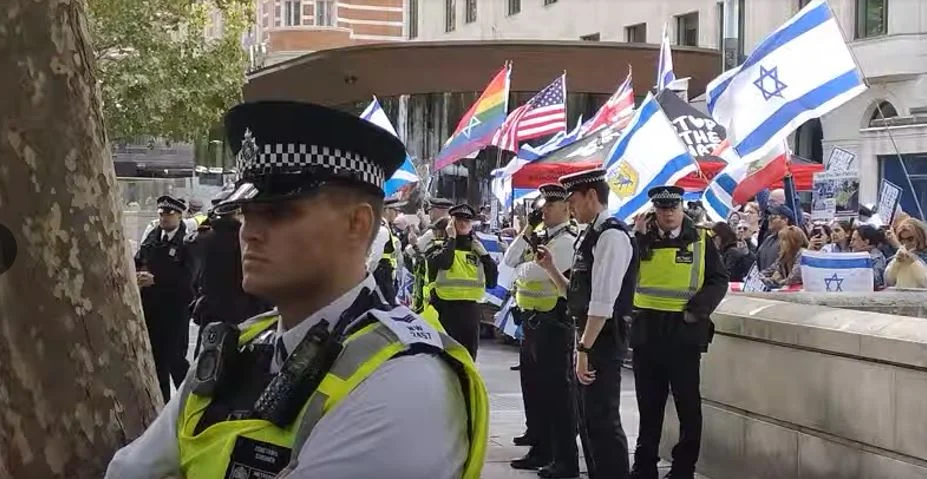
As stated above, the PSC march assembled in the vicinity of Embankment Station before marching past New Scotland Yard and across Westminster Bridge. A near circular route would take them past Waterloo Station, across Waterloo Bridge and along the Strand before finishing with a rally in Whitehall.
The pro-Israeli group ‘Stop the Hate’ had previously withdrawn cooperation from the Met but presumably this had been, at least to some extent, restored: Their protest was to take place outside New Scotland Yard with suitable barriers in place and Israeli flags were clearly visible from the PSC starting point further back along the Embankment. The NSY revolving sign was removed for the occasion.
No masks
The ban on masks was in place and far-right social media posted footage which showed protesters ‘masked up’ at the start of the march. In fact, officers worked assiduously to ‘unmask’ protesters with warnings to the extent that masks were a near unknown rarity as the marchers passed New Scotland Yard. Stop the Hate’ activists would, in any event, have been quick to point out any errant mask wearers to police.
The march itself saw the usual exchange of insults between the pro-Israeli counter-protesters and pro-Palestine marchers. One male was detained and then arrested for being in possession of a Palestine Action banner. He was totally compliant as he was searched and led away in handcuffs.
Red flags in abundance
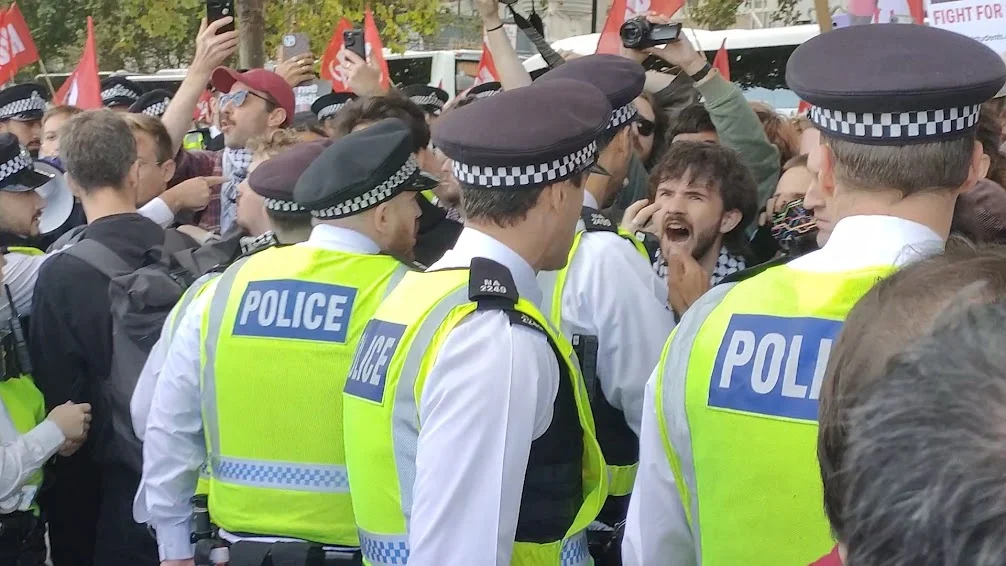
Towards the end of the march a large number of red flags complete with hammer and sickle could be seen from a distance; this was a much larger contingent of young communists than is usually seen. Suddenly, some distance away, across the road, I could see there was a visible commotion as the crowd complete with red flags ‘swirled.’ I noticed three police officers making their way through that forest of red flags.
The march was nearing its end but as it did so, it became apparent that those with the red flags hadn’t continued along the route. Out of curiosity I duly crossed the road and found the young communists somewhat agitated, milling about clearly unhappy with those police officers present. I later found that an officer had been punched in the face after a verbal altercation concerning a mask which resulted in an arrest. Officers had opted to take the prisoner to the wall of the Battle of Britain monument thus ensuring that they couldn’t be attacked from the rear.
The Battle of Britain Monument ‘disrespected’
As is usual in these public order arrests, officers formed a ‘protective’ bubble around the prisoner and the arresting officer. I moved around the back of the monument and ended up at the front near the section where the wreaths are laid. This spot was occupied by a number of protesters. Initially I felt that the wreaths might have been damaged but whilst they were in disarray and on the floor amidst detritus left by the protesters, there was very minor damage to one wreath. The protesters could have shredded them had they the inclination but, apart from any other consideration, politically that would have made no sense given the events of World War Two. The RAF were, in fact, heavily involved in defending the notoriously dangerous Murmansk convoys with some pilots and fighter planes actually being stationed in Russia.
At that moment I heard a noise above me and looked up to see that protesters were on the roof of the monument and being greeted with cheers by those whose feet were still on the ground. This group had somehow climbed onto the roof from the rear and this again led to criticism as to why officers didn’t remove them. In fact, getting onto an already occupied roof is easier said than done while the main focus of public order trained inspectors and sergeants was the extrication of apparently not one but two prisoners. The Battle of Britain monument is not amongst the list of protected monuments covered under Section 161 of the recent Crime and Policing Act therefore merely climbing on it would not be deemed an offence.
Prisoner Extraction
In terms of extracting prisoners there appeared to be two alternatives; the first was to move those arrested using officers as a wedge to drive through the crowd. The second was to force the crowd back in order that those escorting the prisoners would have a ‘clear run’ to safety.
The second option was chosen as some protesters linked arms in anticipation of what was to occur. The resultant unedifying scenes gained much traction on social media but the tactic worked. What had become a mob were pushed far enough back to allow prisoners and their police escorts to leave the scene unimpeded.
Meanwhile those on the roof of the monument had decided to vacate the scene of their temporary triumph as their colleagues were pushed back leaving them exposed. The Met were now very much in control although there was some concern at the length of time it took to assemble sufficient officers given the resources allocated to the protest as a whole.
Young Communists disperse
It would appear that the intention of the 200 Young Communists was to follow the original march route which would take them across Westminster Bridge but police formed a cordon to prevent that. An announcement was then made saying that the group would rally in St. James’s Park. In fact, they turned right into Parliament Street and then up to Whitehall where they merged with the main rally.
There was speculation that the large number of young communists attending was due, in part, to the situation in France. Interestingly most of their chants were in French.
Dispersal and discontent
Speeches from the main stage finished at around 4.30 and the rally was quick to wind down with many people leaving. There was no sign of the Young Communists or their red flags. The Met said that 20 arrests had been made during the course of the march and rally; this included six for offences, including criminal damage, linked to the Battle of Britain monument.
Whilst the presence of Young Communists in such numbers may trouble some within the Met police hierarchy, a more disturbing aspect of the afternoon was the negativity shown by officers towards their employers. The first officer who greeted me is Australia bound in the New Year. Another officer stated that he knows two officers who are now with an Australian force and two others who are due to join shortly.
Officers leaving or intending to leave is a constant theme of conversation with all officers and that is not just my experience. The most damning comment of the day came from a very highly regarded police constable whose policing skills I’ve witnessed at first hand. The comment was short and to the point: “They don’t treat us well.” The officer was not referring to the public.
Chris Hobbs is a former Special Branch officer who follows protests as and observer for Police Oracle.
Advertisement
Job of the week
Police Sergeant – Ascension Island

- Ascension Island Government
- Ascension Island
- £23,968.00 per annum plus food and utilities allowances, free housing and other benefits
This is a unique opportunity to take on a key operational role within the Royal St Helena Police Service on Ascension Island. Working closely with and supporting the Police Inspector, you’ll help provide effective day-to-day supervision, maintain high professional standards and ensure the team delivers a responsive and community-focused policing service. You’ll be a visible and approachable presence for both colleagues and the wider community, offering guidance, making sound operational decisions and helping officers develop their skills and confidence. This is a varied, hands-on role for an experienced Sergeant who enjoys supporting leadership, strengthening a team and making a genuine difference within a close-knit island community.
Read moreCoffee break